
Thursday, August 14, 2014

Thursday, May 15, 2014
The real story of the conflict in western Assam
Even as bodies of children, women and men killed in the
recent violence in western Assam were being buried, rival politicians
jumped in to gain political mileage. The heated exchange among national
leaders over the issue has generated more heat than light, and has
served to mask the complex reality leading to the current conflict in
the region.
This is unfortunate because such irresponsible politicking can sow
the seeds of even greater tension in a bewilderingly diverse and
geo-politically sensitive region, so close to Chicken’s Neck, a stretch
of land just 20 km wide that links the north-east with the rest of
India.
The troubles of western Assam just after elections in
Kokrajhar sprang from the bitter and messy political battle in that
constituency ahead of the elections. Kokrajhar is the administrative
headquarters of the Bodoland Territorial Autonomous District (BTAD),
which has historically elected Bodo lawmakers.
BTAD is a special administrative region comprising four
districts in Assam, created a decade ago after a tripartite peace accord
between the Centre, the state government and former militants belonging
to the Bodo Liberation Tigers (BLT), who gave up their demand for a
separate state in exchange for autonomy. The political party launched by
the former rebels, Bodoland People’s Front, captured power in the
region.
Ahead of this election, the four-time member of Parliament (MP) from Kokrajhar, Sansuma Khungur Bwismuthiary,
was denied a ticket by his own party. Bwismuthiary had acquired the
reputation of a fiery politician among Bodos over the past few years,
thanks largely to his uncharitable remarks on non-Bodos of the state.
Given that the Bodos are not a numerical majority in Kokrajhar, the BPF
probably dropped Bwismuthiary to avoid consolidating the non-Bodo vote,
and instead chose another prominent Bodo leader and former state cabinet
minister, Chandan Brahma.
Bwismuthiary poured cold water on such calculations and
filed his nomination papers as an independent candidate, and weaned a
substantial chunk of his supporters away from the BPF fold to campaign
for him. To add to this, another high-profile candidate, Ranjit Shekhar Mooshahary,
former governor of Meghalaya and former National Security Guards (NSG)
chief, joined the fray on a Trinamool Congress ticket. The influential
All Bodo Students Union (ABSU) extended its support to an independent
candidate, Urkhao Gwra Brahma, a former MP and student leader.
Even as Bodo loyalities were getting divided, non-Bodos rallied behind a common candidate, Naba Kumar Saraniya. Saraniya, who uses the alias Heera,
is a former commander of a dreaded battalion of the United Liberation
Front of Assam (ULFA) and belongs to the Saraniya Kachari tribe.
The tribe is a sub-group of the umbrella Bodo-Kachari
fold, which once encompassed the Bodos and several other plains tribes
of Assam. The Bodos are the largest of Bodo-Kachari ethnicity whose
sub-groups are spread across a few north-eastern states and neighbouring
West Bengal. With the passage of time and changing cultural influences
over the centuries, the Saraniyas, along with several other communities,
have moved away from their heritage and no longer speak the
Bodo-Kachari tongue but a variant closer to Assamese.
Heera Saraniya’s claim of belonging to a scheduled tribe
(ST) was contested by Bodo groups even after the acceptance of his
nomination papers by the Election Commission. Kokrakjhar is a
constituency reserved for STs.
Bodos and non-Bodos have shared an uneasy relationship in
the BTAD for long. The non-Bodos, comprising the caste Assamese, other
tribes, ethnic groups such as the Koch Rajbongshis clamouring for ST
status, Bengali-speaking Hindus and Bengali-speaking Muslims constitute
the majority in BTAD, and the experience of being ruled by a minority
discomfited many.
Saraniya was able to bank on such sentiments and secured
the backing of several influential leaders of non-Bodo communities. The
All Bodoland Minority Students’ Union (ABMSU), dominated largely by
Bengali-speaking Muslims, and a faction of the All Koch Rajbongshi
Students’ Union (AKRSU) came out in open support of Heera Saraniya
during the poll campaigns, asking people to vote for someone who could
represent the cause of non-Bodos in the region.
There were reports about non-Bodos voting en masse for
Saraniya on polling day, making the BPF leadership jittery. Prominent
BPF leaders such as Pramila Rani Brahma made inflammatory remarks
against Muslims of the region, and the attacks on that community
followed a few days later, igniting fears of a repeat of a 2012-like
situation, when more than 100 people from both Bodo and Muslim
communities were killed and hundreds of thousands of Bengali Muslims
fled their homes in panic.
Even in that year, the violence was preceded by sharp
exchanges between an aggressive Bodo leadership, which was mobilizing
opinion for the creation of a separate state, and the Muslims, who
demanded that the BTAD be scrapped as it had not benefited anyone other
than the Bodos. While a substantial section of non-Bodos harbour
resentment against the BTAD, it is the leaders of the Bengali Muslim
community who have been most vocal in their opposition. Already facing
flak or failing to deliver on their promises of developing the BTAD
region, the BPF leadership became insecure and upped the ante against
Muslim settlers.
The politics of competitive extremism in the region and
the consequent polarization is a direct product of the history of
misguided interventions by successive Central and state governments in
addressing the vulnerabilities and insecurities of different communities
living in the region. In trying to pacify one aggrieved ethnic group,
the state has often ended up making other communities insecure,
perpetuating conflict in the region.
When the Bodo movement first sprang up, it was brutally
suppressed. By 2003, the reaction to the movement had moved to the other
extreme, with a willing Centre amending the Indian constitution to
create the BTAD, turning a blind eye to the interests of other
communities. Previously, such a body could only exist in hill areas of
north-eastern states according to the Sixth Schedule of the
constitution.
Creating the BTAD has only served to antagonize the
non-Bodos, lending power to organizations such as the Sanmilita
Janagosthiya Aikyamancha (SJA), an umbrella grouping of 20 non-Bodo
organizations. The chief minister of Assam had to hold out assurances
time and again during his election campaign in this part of the state
that “there would be no further division of Assam”.
The Bodo peace accord has clearly not led to peace in the
region. The other big failure has been the inability to solve the
problem of illegal immigration. As a result, all settlers or
Bengali-speaking Muslims are tarred as Bangladeshis even though a
substantial section among them has been living here since the British
Raj.
The Bangladeshi tag, however, makes all of them soft
targets whenever conflicts flare up in the region. Other communities
such as the ‘adivasis’ have also born the brunt of violence by Bodo
extremists in the past but it is the Bengali-speaking Muslims that have
suffered the greatest casualties over the past three decades in western
Assam.
Unless the mistakes of the past are acknowledged and the
perpetrators of violence brought to book, these incidents of violence
will only prepare the ground for even bigger conflicts in the future. If
the inflamed passions of western Assam are to be doused, both civil
society and the polity have to rise above partisanship and petty
politicking to bring peace to the region.
Source: http://www.livemint.com/Opinion/DkmMauJSK8Wtcxy5F82o7H/The-real-story-of-the-conflict-in-western-Assam.html
Tuesday, April 15, 2014
Social Mobilization for Higher Education: Sequence Exemplar of Tezpur University Jonai Campus Movement 2013
  |
| The Outcome: Mobilizing success |
 |
| The Communication: Diffusion of grievances for action |
 |
| The mobilization: Women's power |
 | |||||
| The issue: Lending a voice |
Social
movement mobilization have taken place across the globe on various
issues. Here's an exemplar of social movement for higher education in
Jonai of Dhemaji district, Assam, India articulated and participated by social organizations,
educationists, students and masses. The above is bottom-up
representation of mobilization of people in symmetry on the issue,
reason for mobilization, communication of grievances through potential
effective channel(the above is Prof Mrinal Miri, noted Indian
educationist) and the outcome of people's mobilization. Social networks
like Facebook, Twitter and MisingOnline were used as communication
tools to diffuse information and updates.The events took place in
April-May 2013. The credit goes to fellow members of
ethnic Mising community and other compassionate participating
subalterns. Despite hurdles created by politicians in connivance with
lackadaisical administrators to block the project, the land allotment
finally took place due to mobilization.(Pictures are not my own.). One
can read more details about this small scale social movement here.
Monday, October 14, 2013
Why Guwahati's Kangkin Kebang flopped this year?
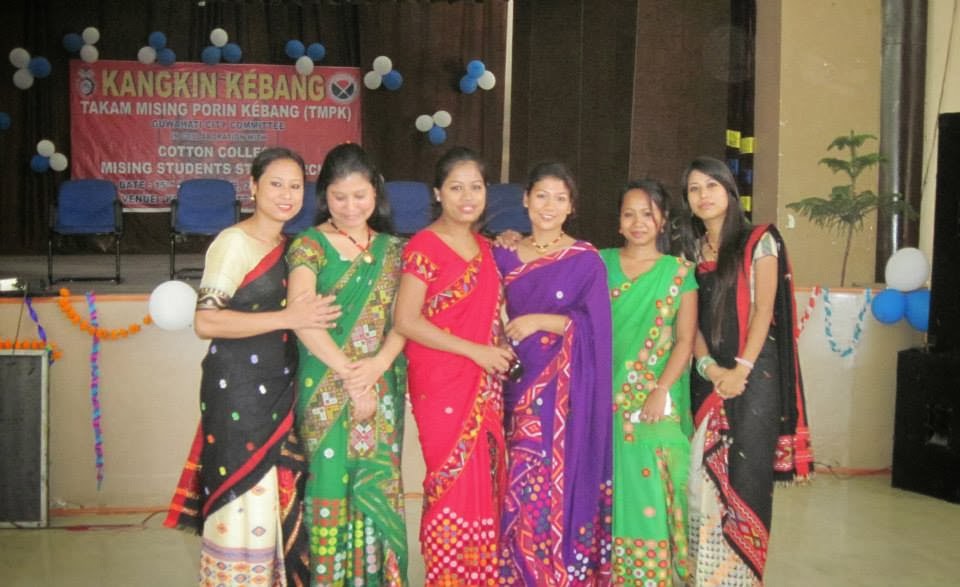 |
| Mising damsels posing for a photograph in KBR Hall. Photo: Payal Doley/ Facebook |
The venue of Kangkin Kebang 2013 (KK'13) was at Kalaguru Bishnu Prasad Rabha hall ( KBR ) in Cotton College on September 15. The organizer of the KK'13, the TMPK, Guwahati City Committee was criticized badly by the student community for the program did not happened as it was supposed. It is said that the Cotton College students were also left discontented. The failure of kangkin kebang became open of social media with many girls and boys expressing about the program. On Facebook some were critical of the Gomug mouth piece, others were dissatisfied with long lectures without any entertainment break. Was this year's kangkin kebang the worst of all?
On October 14, 2013, after almost a month, we had the opportunity to sit down and talk about the flop kangkin kebang. Lila Taye, the president of TMPK, GCC, Rhitu Kumbang and Tanuj Tayeng, all are affiliated to Gauhati University, and I discussed the issue.
Lila pointed out that the main reason for failure
was financial reason. Organizing members including himself were running
managing bucks till the hours of kangkin kebang schedules.
Besides,
when Ganesh Pegu and I was asked to anchor the kangkin sunam
(introductory program of new and old students), the backstage
arrangements such as musical instruments to start off with chorus, was
not ready enough to kick off. So, we took more than hour.
The
program started very late behind schedule. This also prevented the
revelers from having entertainment. The invited guests lecture series
ended in the evening with a lively performance of Gumrag dance by
students of Cotton College. Cotton College's Gumrag was the face-saving
mask of the kebang in the name of cultural program. It really thrilled every watchers.
Why Kangkin Kebang is a serious issue?
Kangkin Kebang is a social gathering exclusively organized for the youths. The new generation students are the society's future of tomorrow.
Kangkin
Kebang, going by it basic meaning, we might not understand the
importance. Our friend Rhitu had said, it's not just a gathering, it has
become an institution of society. Kangkin Kebang is the only program
meant for students in the Mising society. Over the decades of practice
in various towns and colleges, Kangkin Kebang is evolving itself to be a social institution. It must be well organized in such a way where
youths in towns and cities get to interact and introduce not just with new friends, but with the society's traditions, cultures, literature and language. When top personalities lecture before the students, these issues are always cared for.
Some bitter experiences
During my college days at Cotton, I was actively involved in organizing three kangkin kebangs. Of course, now a days with academic pre-occupation I am off from raising funds and circulating invitations actively. This too makes a good a experience being in an organization.
Lila,
Rhitu and Tanuj, had recounted their experiences while going for
raising fund to organized kangkin kebang. What left me shocking, the
encounter they experience with some big people; Some "big people" of
Mising society simply doesn't want heed to KK invitation because their
name are not printed in the program sheets. What they meant, since my
name is not printed I'll not come to Kangkin Kebang, neither I'll help
in donation. Of course, there are equally some excellent people, they
never care whatever is printed. They come forward with cash and kinds to
make the event successful every year.
Wednesday, August 14, 2013
An Adventurous Journey to Sadiya via Mebo- Namsing-Gadum
On July 20, 2013 early morning, Rhitu Kumbang and I set out in a car to the National Highway (NH) 52 from Annapur village of Misamora. Rhitu's plan was to dropped me to the highway to get me passenger vehicle to my home village. The weather was pleasant with no sun rise in the morning, so he offered to take a drive along in the beautiful highway upon reaching Simenchapori.
While driving, I asked him what was the plan for the day where he replied there was no such specific plan as paddy transplanting was almost over in their family. So, my mind just played the idea that whether we should tour to Sadiya. Both of us had never been to there. "Why not we take the car to there?" Rhitu exclaimed. But we did not had sufficient bucks. I countered how could he be so sure of driving the car to Sadiya since we did not had the knowledge of road condition. "Have not you listen oi nitom mentioning about Sumo-Winger vehicles plying to Amarpur, Sadiya? "
Sadiya is a historically significant place. From the chronicles, we come across in where Miri (Mising) tribe had raided and attacked in the territroy of Ahom kingdom till seventeenth century. With the advent of the British after Yandaboo Treaty, 1826, Sadiya had become a place of seeds of Tani languages and literature. British and American Missionaries left the place with indelible mark among the present Adi and Mising people. J.H. Lorrain's " A Dictionary of Abor-Miri Language" (1906) is the earliest ever lexicography produced in those times in Tani language. Other contributions includes J.F Needham's "An Outline Grammar of Shaiyang Miri Language" (1866), collection of folk story in Padam clan language. And in modern times, because of the inaccessible surface communication Sadiya was a safe haven of insurgent outfits where cadres moved around freely in island villages. Even red rebels are gaining ground as the media of late has reported. Many things were heard, never seen.
With all these exciting impressions in mind we plan to see the tip of Mising habitat, immortalized in many well-known folk songs in Mising society. We passed via the proposed Jonai campus Tezpur University in Majulipur village and reached our home. Rhitu and I had light breakfast given by Mom.
Then we drove to Jonai to meet Bhisma Doley, once a senior who now works in a college. We exchanged our car with his bike. We filled few litres of petrol at Ruksin and moved towards Pasighat.
Rhitu clean shaved and cut his hair in a salon. I bought some chocolates and chips in the town. We moved towards Mebo. We passed the beautiful Raneghat bridge over Siang. The highway was very clean with green forest on either sides with absence of man and vehicles. We crossed the famous knee-deep beautiful Siku river immortalized in oi ni:tom.
We reached an intersection where we found signboards indicating Mebo town. We asked about the route to petrol pump men in an fuel re-filling station. "You have to go straight to reach Gadum Tiniali. It is 58 kilometres from here. Amarpur is not far from there". (For details on driving direction from Jonai to Amarpur, please refer this link of Google maps. Also see text display .)
Then the adventurous journey begun! No village, no people, only thick forest! We rode along the unknown small metalled road with scary mind imagining of wild animals and robbers with sword!
There are few villages in between Mebo and Gadum namely Ngopok, Serum, Borguli, Namsing. And again, the imagery about these places is drawn only from one source--Oi ni:tom! We sung in the top of our voices with beating heart in the jungle road. We passed small wooden and iron bridges over streams and rivers.
We passed the Serum korong (literal meaning for river in Adi and Mising). We drank water of the river and also had a face-wash with cream. People generally speaks Adi language here, which is very much intelligible to Mising except the variation in tone. On the hut shades in the river bank, we saw a retiring middle-aged couple while listening to melodious old oi ni:tom of Kunjalata Kaman. When they came to know that we were from Jonai, the avid oi nitom listeners curiously wanted to verify a rumor from us, " Heard Tongki had gone mad, is it true?" (Tongki bi simad kang emna tattungai, arroi?). We smiled and told them that we did not know about it that we too stay in Guwahati although we belongs to Jonai.
We saw a group of damsels carrying a rifle most probably on their way to farm at Borguli. Rhitu and I did not dare to stare these damsels!
There are repaired wooden bridges. Local people who look after the bridges charges Rs. 20/ 30 from travellers with vehicles. The road where there are villages are stained with cow dung. Males are generally seen wielding dao as it happens to be a forest area.
There is a ghat after crossing Namsing. It is known as Taro-Tamak. We saw an old and long incomplete iron bridge stained with rust.
We reached Gadum Tiniali nearly at 1 pm. We looked for tea shop and found one where we ate puris as we were hungry served by a Gorkha woman.
We asked a couple on bike on how to reach Dotung ghat. People here generally tells travellers "Inde" (meaning there) when asked about distance to a place letting you presumed that it's in a stone's throw distance! Actually, it is not the case exactly, may I provide you with a tip---it's not less than 5 km!
Gadum is a place with vast arable land with thin habitation. One would see stilted Mising houses with thatch roof in the country-sides in pictureque green background. We rode down from metalled road of Gadum to reach Amarpur. You have to passed through chapori in muddy road. If you are lucky, you come across vehicles in the forest coming from Roing that passes via Dibang and Dotung ghats. Of course, there are cattle-grazers and cowsheds which is true of every chapori.
We crossed the Dotung ghat in country boat managed by local villagers. We went first to the famous Kedan Baazar where a weekly market is seated every Sunday. The bike was puncture just after crossing the Dotung ghat. It took almost two hours to find the small nail stuck in the back wheel by the mechanic and fix it back. This place of Amarpur came to prominence when the Takam Mising Porin Kebang (TMPK) once organized their central committee conference in 2008. Amarpur is an island and falls in Tinsukia district of Assam. The northern side across the river falls in Lower Dibang Valley district of Arunachal. The region of Assam is called Sadiya. It is said that there is no proper demarcation of boundary between Assam and Arunachal here. Land entitlements and permanent residence certificates keep worrying the minds of the people. Both sides are inhabited by Mising people.
It was a sun set hour. We passed village after village in this unknown and new place to reach to a house we were looking for. When we reached, we came to know the person was not at home. We knew only one person in this unknown place, that too was not there! Rhitu was red-faced and I was speechless, we rode back via the muddy road and sat in an intersection thinking of where to proceed. In the twilight, we were left in a situation of --No Where To Go! To back to Jonai, there is the fierce jungle road. To reach the Chapakhowa town, we did not know the distance and possibility of getting ferry was thin! All our adventurous journey ended up in smoke!
However, we managed to refuge ourselves in an stranger's house near a lower primary school in the night!
While driving, I asked him what was the plan for the day where he replied there was no such specific plan as paddy transplanting was almost over in their family. So, my mind just played the idea that whether we should tour to Sadiya. Both of us had never been to there. "Why not we take the car to there?" Rhitu exclaimed. But we did not had sufficient bucks. I countered how could he be so sure of driving the car to Sadiya since we did not had the knowledge of road condition. "Have not you listen oi nitom mentioning about Sumo-Winger vehicles plying to Amarpur, Sadiya? "
Sadiya is a historically significant place. From the chronicles, we come across in where Miri (Mising) tribe had raided and attacked in the territroy of Ahom kingdom till seventeenth century. With the advent of the British after Yandaboo Treaty, 1826, Sadiya had become a place of seeds of Tani languages and literature. British and American Missionaries left the place with indelible mark among the present Adi and Mising people. J.H. Lorrain's " A Dictionary of Abor-Miri Language" (1906) is the earliest ever lexicography produced in those times in Tani language. Other contributions includes J.F Needham's "An Outline Grammar of Shaiyang Miri Language" (1866), collection of folk story in Padam clan language. And in modern times, because of the inaccessible surface communication Sadiya was a safe haven of insurgent outfits where cadres moved around freely in island villages. Even red rebels are gaining ground as the media of late has reported. Many things were heard, never seen.
With all these exciting impressions in mind we plan to see the tip of Mising habitat, immortalized in many well-known folk songs in Mising society. We passed via the proposed Jonai campus Tezpur University in Majulipur village and reached our home. Rhitu and I had light breakfast given by Mom.
Then we drove to Jonai to meet Bhisma Doley, once a senior who now works in a college. We exchanged our car with his bike. We filled few litres of petrol at Ruksin and moved towards Pasighat.
Rhitu clean shaved and cut his hair in a salon. I bought some chocolates and chips in the town. We moved towards Mebo. We passed the beautiful Raneghat bridge over Siang. The highway was very clean with green forest on either sides with absence of man and vehicles. We crossed the famous knee-deep beautiful Siku river immortalized in oi ni:tom.
We reached an intersection where we found signboards indicating Mebo town. We asked about the route to petrol pump men in an fuel re-filling station. "You have to go straight to reach Gadum Tiniali. It is 58 kilometres from here. Amarpur is not far from there". (For details on driving direction from Jonai to Amarpur, please refer this link of Google maps. Also see text display .)
Then the adventurous journey begun! No village, no people, only thick forest! We rode along the unknown small metalled road with scary mind imagining of wild animals and robbers with sword!
There are few villages in between Mebo and Gadum namely Ngopok, Serum, Borguli, Namsing. And again, the imagery about these places is drawn only from one source--Oi ni:tom! We sung in the top of our voices with beating heart in the jungle road. We passed small wooden and iron bridges over streams and rivers.
We passed the Serum korong (literal meaning for river in Adi and Mising). We drank water of the river and also had a face-wash with cream. People generally speaks Adi language here, which is very much intelligible to Mising except the variation in tone. On the hut shades in the river bank, we saw a retiring middle-aged couple while listening to melodious old oi ni:tom of Kunjalata Kaman. When they came to know that we were from Jonai, the avid oi nitom listeners curiously wanted to verify a rumor from us, " Heard Tongki had gone mad, is it true?" (Tongki bi simad kang emna tattungai, arroi?). We smiled and told them that we did not know about it that we too stay in Guwahati although we belongs to Jonai.
We saw a group of damsels carrying a rifle most probably on their way to farm at Borguli. Rhitu and I did not dare to stare these damsels!
There are repaired wooden bridges. Local people who look after the bridges charges Rs. 20/ 30 from travellers with vehicles. The road where there are villages are stained with cow dung. Males are generally seen wielding dao as it happens to be a forest area.
There is a ghat after crossing Namsing. It is known as Taro-Tamak. We saw an old and long incomplete iron bridge stained with rust.
We reached Gadum Tiniali nearly at 1 pm. We looked for tea shop and found one where we ate puris as we were hungry served by a Gorkha woman.
We asked a couple on bike on how to reach Dotung ghat. People here generally tells travellers "Inde" (meaning there) when asked about distance to a place letting you presumed that it's in a stone's throw distance! Actually, it is not the case exactly, may I provide you with a tip---it's not less than 5 km!
Gadum is a place with vast arable land with thin habitation. One would see stilted Mising houses with thatch roof in the country-sides in pictureque green background. We rode down from metalled road of Gadum to reach Amarpur. You have to passed through chapori in muddy road. If you are lucky, you come across vehicles in the forest coming from Roing that passes via Dibang and Dotung ghats. Of course, there are cattle-grazers and cowsheds which is true of every chapori.
We crossed the Dotung ghat in country boat managed by local villagers. We went first to the famous Kedan Baazar where a weekly market is seated every Sunday. The bike was puncture just after crossing the Dotung ghat. It took almost two hours to find the small nail stuck in the back wheel by the mechanic and fix it back. This place of Amarpur came to prominence when the Takam Mising Porin Kebang (TMPK) once organized their central committee conference in 2008. Amarpur is an island and falls in Tinsukia district of Assam. The northern side across the river falls in Lower Dibang Valley district of Arunachal. The region of Assam is called Sadiya. It is said that there is no proper demarcation of boundary between Assam and Arunachal here. Land entitlements and permanent residence certificates keep worrying the minds of the people. Both sides are inhabited by Mising people.
It was a sun set hour. We passed village after village in this unknown and new place to reach to a house we were looking for. When we reached, we came to know the person was not at home. We knew only one person in this unknown place, that too was not there! Rhitu was red-faced and I was speechless, we rode back via the muddy road and sat in an intersection thinking of where to proceed. In the twilight, we were left in a situation of --No Where To Go! To back to Jonai, there is the fierce jungle road. To reach the Chapakhowa town, we did not know the distance and possibility of getting ferry was thin! All our adventurous journey ended up in smoke!
However, we managed to refuge ourselves in an stranger's house near a lower primary school in the night!
Wednesday, July 24, 2013
Inside Arunachal Hill: Biking on the edge of river Siang
On July 18, 2013, Brian Orland and I rode off to
Pasighat from Jonai, 35 km away from this small town. The day was drizzling since morning which delayed
our planned timing by four hours. The previous night we had plan in mind
to reach Amarpur of Sadiya and tried tracking the place on Google Maps.
However, the rain gods didn't favour us in the following day.
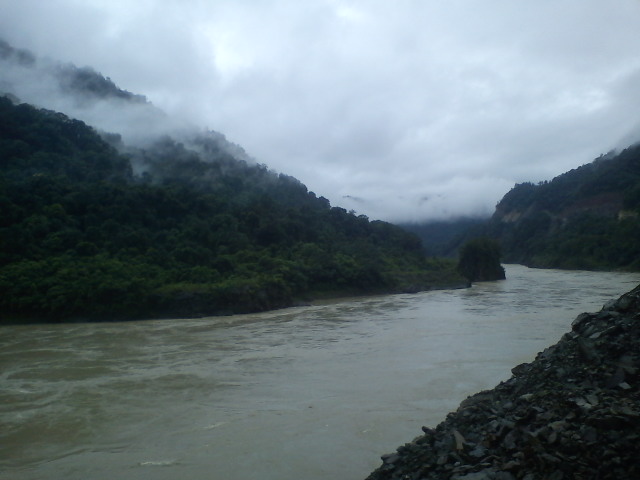 |
| Siang river |
After
sipping coffee in a restaurant named 9 to 9 at Jonai town, we moved out
slowly on a red pulsar bike at 10 am. We halted at Oyan to take tea.
 |
| Pebble pathway |
The highway was in developing condition, we had a challenging drive to our destination. At first we had our lunch near the forest check gate in this oldest town of Arunachal Pradesh.
Edging dangerously along the Siang
 |
| How far is China? |
We saw many tiny waterfalls along the way that were merging into mighty Siang.
We stopped over at a rocky hills stretch of the under constructed road. It was a dangerous rock hill slope with constant chances of slide. After staying fifteen minutes or so, we saw pebbles rolling down the slope.
As soon as I heard the sound, I looked up to the slope. We all were fear struck seeing the pebbles that indicated of possible land slide.We were standing on the edge of river Siang. We immediately left the place.
At Bodak village and the land slide
We rode our bike up to Bodak village, a Padam clan rural setting of Adi tribe not far from the road and the river. We walked up to the house of head man, locally known as Gam. Brian and we all had a chit-chat with the head man on issues of development, economy, livelihood, and possible consequences of dam developing near their village. The head man's wife offered us tea and biscuits.
 |
| Clouded mountain |
It was nearing 3 pm. We left Bodak. We were driving back to the down town. On our way back, we found the road being block by a huge pile of mud. We were told that just fifteen minutes ago the landslide had happened and the mud-removing vehicle will take 30 minutes or so to clear the road.
We waited for more than an hour. The mud was removed. We drove down to pass the Raneghat bridge and bade good bye to Omik and his cousin from the town.
 |
| Post-landslide |
This one day monsoon drive was really a worth remembering experience in my life.
Saturday, May 4, 2013
Become a part of the Jonai Campus University Movement
 |
| Villagers and students during Highway blockade burnt tyres on April 29 |

Wednesday, May 1, 2013
Brahmaputra river: Eroding Land of the Misings of Gohpur in Assam
I was in Gohpur's Mising villages on the day of Bihu this year. Towards south of National Highway 52 from Gohpur town in Sonitpur district of Assam, there are number of villages inhabited by Mising people till the immediate bank ( some are even after crossing it!) of Brahmaputra river.
We enjoyed Bihu with our friends based in number of villages, most of whom were in home during Bihu holidays. So far I can recall, the name of villages we toured were Dondhi, Letburung, Choraibari, Lohitmukh, Pichola etc. Our gang of friends, most of whom were university students , when we reached Choraibari village, near the embankment joined local youths in merry-making . Some seized the cymbals, others picked the drums. Then, we were almost forced by a group of damsels to sing oi nitom, our folk song. We enjoyed in courtyard of taléng okum.
We were on bike. We rode through the muddy road cum embankment along beautiful taléng okum/ stilt house in the villages. A guy named Pabitra took me and another friend to the river side in Amguri Pichola near Lohitmukh. I was taken aback by images, a mighty river marauding people's dwellings and farmlands. I cursed myself I could not do anything to stop the beautiful land from eroding. We saw families packing their belongings to safer location with the increasing onslaught of the river. When many people are absorbed with Mising Autonmous Council (MAC) boundary and election, I was witnessing helplessly shrinking land that falls in MAC. I am sharing the pictures which I captured with a friend's cellphone.
Can't we have a long term measure to stop erosion? What happened to the policy makers who promised of protecting the lives and property of people? Doesn't we have an engineer in the country who can make foolproof embankment rather than just sand filled long dykes? We can create billion of scams, not embankment. I'm sharing only these heart-pounding pictures , not the celebration ones in protest. This blog is dedicated to all struggling people of river banks who are serially been ignored, marginalized and excluded from the fruits of Indian democracy, whose votes are valued only during election.
I'm sure that no one will intervene or assist, I will not see the river banks, the river side stilt houses, the green paddy farm any more when I visit next time. Because, this is Assam, and suffering people here are Mising!
( I am thankful to all my friends of the villages of Gohpur. Special thanks to Pabitra who took me to the river side.)
We enjoyed Bihu with our friends based in number of villages, most of whom were in home during Bihu holidays. So far I can recall, the name of villages we toured were Dondhi, Letburung, Choraibari, Lohitmukh, Pichola etc. Our gang of friends, most of whom were university students , when we reached Choraibari village, near the embankment joined local youths in merry-making . Some seized the cymbals, others picked the drums. Then, we were almost forced by a group of damsels to sing oi nitom, our folk song. We enjoyed in courtyard of taléng okum.
 |
| Portion of land falling into river Brahmaputra in Pichola |
 |
| Women collects firewood from the river side. |
 |
| This will be devoured soon, cause of people's silent weeping. |
I'm sure that no one will intervene or assist, I will not see the river banks, the river side stilt houses, the green paddy farm any more when I visit next time. Because, this is Assam, and suffering people here are Mising!
( I am thankful to all my friends of the villages of Gohpur. Special thanks to Pabitra who took me to the river side.)
 |
| Sandcasting: This was once a fertile farm land and human habitat |
 | ||
| "When we were in our childhood, we have to walk miles with packed meals to reach the ghat. Today, it is here". |
Thursday, March 28, 2013
Easing Youth Unemployment in Assam: A Talk with Security Guard Trainees
 |
| Getting ready for drill |
 |
| View from NH 37 |
 |
| Babul and me with boys from our place |
Babul and I went to see our village
guys on the day of Holi festival to Agchia who were undergoing training program to
become security guards. Since it was a holiday in IIT, we caught a bus to the
place from Jalukbari at about 11 am. Reaching there, we were surprised to see
many guys speaking our tongue housed in bamboo made single-side tin roofed camps.
The camp where our guys were staying was bustling with oi nitoms on cell phones
and some chit-chatting in slang-mix serious talks.
We
were welcomed by our boys with non-veg lunch. One cousin of mine quipped,
" You guys are lucky that you come today, we have meat curry". We
quickly ate the food which was served with two chillies. " Brother, we
don't have enough water today", one of them rued complaining about the
inadequacies of water supply even to take bath after playing Holi, the
colour-soaking festival of India.
After lunch, we all sat down in the bamboo made large-rowed bed. They talked
about the rules and regulations during the training, of problems and prospects,
their aspirations and future in Indian cities. One of the guys older than me
from our village, an arts graduate replied me when I asked him why had he come
here, " No deal eh! I"ll go to Paresh Baruah (of Ulfa) after
completing my training here. We have learned everything now except firing
guns!". His nickname is Rabon.
During our childhood days, we used to sit in circle at a roadside village
ground in the evening and sung hit Adi and Galo songs( "Sai sai sina was
one!)clapping like an orchestra. Since our villages lies in the border of
Arunachal, we have had natural inclination to learn song and language of the
other side. There were many elders in our village who could speak impeccable
Galo tongue and used to kid us with new lingo. Rabon was one who once led us introduced to the world of neighbouring cultures.
I knew Rabon was kidding about Ulfa and he revealed us later that his elder
sister who was recently married off have sent him to attend the government
initiated free training program after selling a big swine. " You know my
old mom is alone at home now, they are concern about my future so I came here.
Otherwise, I would have gone fishing in the ponds today if I were in village".
The guys from our place told us that there are highest number of trainees from
Dhemaji district. " There is an Assamese guy, you know he is a head
master's son from Silapathar and he is a graduate too. His elder brother is also
a TET teacher. If a person from his background can come, why not guys
like us who have nothing at home". " This is the last ditch attempt
to build my life. If I can saved money for an auto-rickshaw after my employment
as security guard, I'll return home soon."
We discussed many things what others may just consider as crap. From the
talk of campus varsity at Jonai to politics: Sixth Schedule, MAC elections,
unemployment and nature of village youths. Some younger guys immediately
left our crap talks when it was alerted from the threshold that girls were
coming. A guy facing towards me said, " Arope biro, ko:neng
kangkikuma:nam bojeko idakbo, ngo ka:po:ye!" (Really brother, I have not
seen girls for days, I am going out to see!". " I don't know why they are
so crazy, can't they have patience for 35 days without seeing girl", one
of them mumbled. I know the boys were desperately missing their rural
environment here.
I asked one of my cousins, "What about your study? Did
you left?" " They will let me appear in class 12. My
parents have allowed me to come here", he replied. Rabon added that my
cousin was having his class 11 exams, he left it and come. Rabon said, "
It is good that he join us. Otherwise he have been taking dendrite and grass
there. He was narrowly restored from the drug gang. All sorts of
intoxicant stuffs have ruined our village boys these days. Those who have
stayed back are doing nothing except playing cards, drinking and bringing bride. At village,
you know you ate your food and wander without work whole day. Here at least, government is
providing everything from food to uniforms, we are learning something for our
lives too".
More than four hundred youths from various districts of rural Assam are
undergoing training program for private security guard under the aegis of
government of Assam's Employment Generation Mission at Agchia, about 35 kms
from Guwahati. The training program is provided free of cost for 35 days which
includes physical fitness, discipline and regulation, fire fighting techniques
etc.
They are being trained by ex-Indian army. The initiative is taken by government
of Assam in order to minimize burgeoning unemployment in the state. The minimum
education qualification to join this program is matriculation.
@
All photographs are courtesy of Babul Doley
Friday, March 1, 2013
Ali-A:ye Lígang Longédok Dairi
February 13, 2013: Ginmur po:lo a:la
asinang okanodo:pé ésar sarradungai, pítír kurak la dungai daggabnam amo:dé.
Luki ésar sarra anné kaman ísíng amíng kídídém
moyo sula dung lambé kéra do írga:né lutadko bombi dungkunémpé. Singgi appun
punna lí:jík lí:jík pé appíloi ka:po la
dung. Koka dokkémpé tagad appun punamém
kabek tokuma émdaggom, silo-mélo tagad amingém bojéko ka:bekma. Lígang sém
borík supé okoiko pí:ram dagnémpé ila dungai.
Tako Gí:tu dok Mé:mipénam Dírbí Karé
Suk bírduk so ngo do:lupé gíkaku Ali-A:ye Lígang (AAL) kangkolo. Dítak kínít
ko ikangaboi ngok sí:sang ko do:ludo Lígang kangkima:namé. Tiket pa:ma:la
Guwahati Inter State Bus Terminus (ISBT) dokké Laimekuri pé Assam Valley baslo kebin ara:do tetmíndanna gíku. Okum érang tani odokké ajon-arum lédulo
gí:dí-sípí ém ka:pé émna toktoku IIT Guwahati dok mélík (leave) langge:la.
Rokom kínít anin ayirdo bas lokké gíy
danna ngo Tako Gí:tung LP school lotta do dírbí iko karéko ka:bekto.
Lígang longai odo, tetgéng (chair) ém bojéko pa:sala létak. Bagémpé méngkang,
“Arey, okai dírbí léngkan kane méyum? Okkan sé bulu, Lígang sé sémpéi ikangkun
su!”
Akula du:né poka lamtédok do:lupé alé daman
daman la gíku kabeknam karédo agom mé:mila. Lambédo ajon Natukali, Tanibhai
bulum ríksuto. Kangkinnam taniyém ríksunamdéméi
aidun-aiman émna tatbomla-tatbomla okumpé pí:toku.
Bulukangké Lígang Dumdum Manbonam Do:ying
 |
| Ngoluk do:lung so:man.... |
Longédo aso aso:pé tanyi yatkumsudu:bo
do:lung dírbí lottadop. Ya:me-mímbír, milo-yaméng, miné-míjíng géru-bomru sula
takam gíngab du:bo. Kajé irobla:boi émna sékai-sékai jé:bom du:bo, yummayiryé
sémpé il du:mílo, édílo soman-yirmanyén, édílo doman-tímanyén?
Dum dum lu:pi manrob la:boi émnamé, dum dum
mankin né tani kama, Líggod kapé iyén? Ya:me ko kídísok sékosinne dumdum
mankinné katoman émna sékai abín taniko sékomsin suttékmap apping tatdop
ge:dung. Mankinné ngoluk ta:to Digholangkésin alak ser dung, supak sék
manboyan?
Odo ayirdo Buluka émnam míjí dém sékai
mé:pa:to. Élo, Buluka bí Líga lo do:lu so lendagada, su okolan? Tatgonammé lubidak Lígang longé lok mé:panam
dum dum manjo:né ta:to Bulukabí ríkkong ké do:lung ko:lo manboka ro:do, odok
lédupé kekonké doludém manbola dung. Édém manaboge:la:pak ngoluk do:lupé gísa:yé.
Lunamí démpé lédupé bí gído, odokképak
dírbí lotta dé írgangkang.
Ko:ka dokkébo ka:tak Buluka ta:to bím, ru:be dak émna de:gé dolung
amme lukadak lékom lamté-béda:lo. Yamné kamang . Amilo pagbo kísapé gerra aíké
donamém bí la:len sudak. Émmum taniyé dítak dok angu longé kídído, émpigel bí
ma:mílo ngoluk mé:bomsunam dírbí tarungé ingabla:ma. Aro:pé mé:yém, réngam
ara:so Bulukang kémpin dírbí migang éddík du:song? Dumér ako sékai édílai tulík
kítan?
Oi ni:tom, lotta so:man élang baik pamsarnam!
Yumé ayirdo do:lung ajon lédulo ngo:sin
apong tínggo-dogo mannam taru do a:mínto. Do:lung ajon émyém yamné la:no ngébo
abayang, akelokké obo akosin idu:bo! Okumbomna dola du:bo ngok sí:sa jonsunamé
supak, lékom ngo okkom il dun émna mé:dak! Porila dungkolo sémpé idakbona
émna mé:yin sula du:doku!
Oi
ni:tom, kaban sékoi okkom pagdakji moset-moret bomdanna okum okum lo ír bola
dungai takamé, sékai odo ara:do modagai ngok tatkí ma:nam oi ko sémpé: O: bí
mé:nam do gíge:la, Bau bí mé:nam dém langge:la, kapila ngom lutum dun ngokké oi
mé la:pé mé:dosom, O:bí sí:sang ayir pangkar ma:némpé, Bau bí sí:sang ayir
gibadar kímanémpé...
Yirman-soman ara ngí:do ngokké Koton Kolej
do po:pé ké senior akolok phon angkang. Bi ngoluk do:lung kérangíng kolo dung
lotta soman ka:la,ngom ríksu:yé émdak. Facebook do AAL yalo update lok ngo gísa
dungku émnam kinla nombor dém amikolok magabgel phon dung émto. Oh! Technology lok tani okol duji édémsin an-gab
la:named vmmumémpé ikangku émnam dém aropé kinsék suto odo.
Ngolu ríksula kekonké do:lung do mibo ya:me
émsula ba:pi-bangok oi ni:tom moto. Koton Kolej dok hostel du:do dokkém ngolu mé:pa
langkula Disangmukhoi Ophola démsin paklíktoku!
Jonai
pé yumé do gísané senior annyi lédulo, lékop dulangkui émna. Junkaréng ruyi do baik pamsar kang kinso:map.
Tolopésin mo:tédak, bolopésin mo:tédak, NH 52 do ngolu kapiyen supak?
Beteri kéik la du:ne ngok mobail so ayir dém ka:toném 10.30 dakbo. Ajon-arum ém phone ila du:dom
Maruti 800 kar ako duksa:do, ngoluk lambé
ríson dok dakla du:nam dém ka:la sékai gari ara:dokké amin ako jénggel du:tet
kang. Ka:toném ngoluk ajon Dhononjoy Modi ké biro lok ajon appiko dung, bulusin
Silapothar bokké Lígang dogel gídungku. Gepla du:né gari ara:ngí:do ngolang
ajon ako dura mínto, Bhismo bí baik dém atér dé kapéi daggom dukbomyéku émnam
dém togésukang.
Yumédo Jonai dok Bhaskor Tayeng, odokké
ajon Mintu Régon annyi dé pongkokdokké dukríksula pí:toku. Ngasodlok pa:nam
dé:pak aro ajoné!
Ali-A:yé Lígang
Borík Yumdéng Agom
Jonai pé pí:salangkula Lí:sang do:lung
pí:né Bhismo ké rumdo:pé. Mimak moné ajon Mintu Régon mé ríksula Jonai modi dok ‘latest update’ tatka. AAL
soman-yirman mépakge:la ngolum gíríksukol gínamdém bí lugela sémpé gompir ékké
pirsarto. Mg. Régonbí suk dítak sokké anu dírlab ko la:len dung émnamdém
kinmoto.
Do:lung-lujar takamlo Ali-A:ye Lígang
boríksunam tarung ko igurbodung, okkon émtoném “Ali-A:ye Lígang Borík Yumdéng”
(AALBY) émtak. Yampo Lígang émdo yumédo réngamé (ya:me-mímbír!) AAL ém
ír-pongkír pé ager-atung gerla, gumrag soman-yirman, purang apin, ambuk atí-atí
amanla du:dope édé taru dé. Pagmílo karé mosa danna mojo-molabné ni:tom tuli
gokla AAL kangkanpé borík sudopé idung.
Mg. Régonké lubidak lédup kinsékto Tako
Gí:tung dok dírbí karédé oko légang motagaji! Takunammé ni:tom tuli Toraboti
Bori bí:lang Sorbeswor Kardong bí gídagai émdak méyum, kinnoyamílo kangkol gísangkupé
nammai! AAL borík yumédé éddíko ngoluk sí:sangém Oang Dírbí (Western Culture) mé:bonammém
motum layén édémpak mé:mipénamé, tatge:la mé:to.
Ayirdém ka:namé yumé 12 yébo. Aíké du:télop
ainé yumé émgel gípan sukuné.
Subscribe to:
Posts (Atom)

-
GUWAHATI,Jan 13:The elite Tani student organisation Takam Mising Porin Kébang(TMPK) and Mising Dírbí Kébang(Mising Cultural Association) hav...
