On July 18, 2013, Brian Orland and I rode off to
Pasighat from Jonai, 35 km away from this small town. The day was drizzling since morning which delayed
our planned timing by four hours. The previous night we had plan in mind
to reach Amarpur of Sadiya and tried tracking the place on Google Maps.
However, the rain gods didn't favour us in the following day.
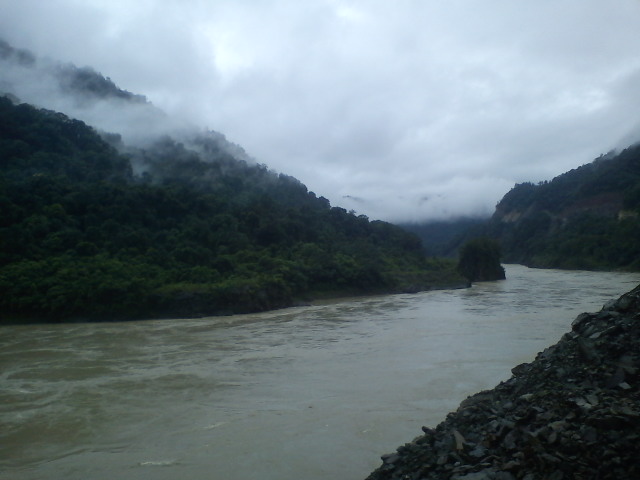
Siang river
Biking on drizzling highway
After
sipping coffee in a restaurant named 9 to 9 at Jonai town, we moved out
slowly on a red pulsar bike at 10 am. We halted at Oyan to take tea.
Pebble pathway
All
the way to Pasighat, we were seeing people busy in their farm work
planting paddies in the field.
The highway was in developing condition,
we had a challenging drive to our destination. At first we had our lunch
near the forest check gate in this oldest town of Arunachal Pradesh.
Brian
called up a guy named Omik Permey and sought his assistance to visit
the villages along the Siang river inside the hills. Omik and his cousin
came out.
Edging dangerously along the Siang
How far is China?
We
crossed a check gate and drove along the newly constructed black topped
concrete road. Locals warned us of possible landslides due to incessant
rains along the under construction road.
We saw many tiny waterfalls along the way that were merging into mighty Siang.
We travelled along the muddy road while having a classy view of Siang river and the thinly clouded green hills.
We
stopped over at a rocky hills stretch of the under constructed road. It
was a dangerous rock hill slope with constant chances of slide. After
staying fifteen minutes or so, we saw pebbles rolling down the slope.
As
soon as I heard the sound, I looked up to the slope. We all were fear
struck seeing the pebbles that indicated of possible land slide.We were
standing on the edge of river Siang. We immediately left the place.
At Bodak village and the land slide
We rode our bike up to Bodak village, a Padam clan rural
setting of Adi tribe not far from the road and the river. We walked up
to the house of head man, locally known as Gam. Brian and we all had a
chit-chat with the head man on issues of development, economy,
livelihood, and possible consequences of dam developing near their
village. The head man's wife offered us tea and biscuits.
Clouded mountain
It was nearing 3 pm. We left Bodak. We were driving back to
the down town. On our way back, we found the road being block by a huge
pile of mud. We were told that just fifteen minutes ago the landslide
had happened and the mud-removing vehicle will take 30 minutes or so to
clear the road.
We waited for more than an hour. The mud
was removed. We drove down to pass the Raneghat bridge and bade good bye
to Omik and his cousin from the town.
Post-landslide
This one day monsoon drive was really a worth remembering experience in my life.
Talom Rukbo,the ambassador of cultural renaissance
Does religion,faith and worship still hold importance to the people in this hyper liberal individualist world? Have you ever imagined people’s skyrocketing participation even in this age on socio-religious movement that was reawakened just two and half decades ago? The Donyi-Polo Yelam Kébang(DPYK),(but spelt as Do:nyi Po:lo as per dialectic tone of the Tanis,also in their religious book,in recent nomenclature too)the brainchild of late Talom Rukbo ,that kick started its reawakening movement at Pasighat back in 1986 has now gathered into eminence among the Tani peoples of Assam and Arunachal Pradesh.A person from Along in West Siang district who happened to be Talom Rukbo's contemporary said in his deliberation that Rukbo initiated cultural renaissance in the Northeastern region among the indigenous peoples.The silver jubilee year celebration of Donyi Polo movement,considered as the indigenous faith since ancient times; commemorating Talom Rukbo,the socio-religious reformer,witnessed thousands of participation of delegates from as far as Tuting near China border in Arunachal Pradesh to Tsangpo/Siang/Brahmaputra’s largest deltaic island Majuli in the plains of Assam.The Tani people are none other than Adi,Nyishi,Galo,Mising,Tagin,Hill Miri tribes,also well-known as the descendants of Abo Tani.The Tani people habitats are the plains and hills in the states of Assam,Arunachal Pradesh of India and part of Tibet Autonomous Region(TAR) of China.
The Central Ganggiing ground,the venue where the event saw the large gathering
Return of the 'traditions' against 'modernity'?
The Donyi Polo as an indigenous faith has been gaining momentum that was clear from the large number of participation in the recently held 25 years of revival celebration at the place where it regained its movement from 01 to 03 December,2011.It is equally important to think why the ancient faith that was limited only to communities and households practices has seen increasing number of people’s participation.The modernization that comes to contact in the form of development in education,communication and exchange of ideas along with socio-economic and political implications among the tribes previously untouched by modern civilizations have huge impact in the thinking and perception of the people.First it was Christian Missionaries who reached out to the Tani tribes followed by administration of the colonial government,and finally the national government after it India attained Independence.Whether it may be the conscious educated masses’ emotional bonding to one’s culture,language,faith,origin,race,ethnicity that were once educated by Christian or Hindu Missionaries or their deep attachment towards ‘traditional’ spirituality the Donyi Polo movement has thousand reasons to smile to-day,that too in this market defined-destiny of the world.It is significant to mentioned the critical debates of the academic circles here that the Marxists thought modernization would usher development of inevitable class consciousness that would strike at the root of ethnicity.Again,Emile Durkheim,the eminent sociologist,said the growth of individualism will make the ethnic groupings more or less redundant;Max Weber emphasized that ‘rationality ‘ would strike the root of ‘traditional’ structures.Although they may not have used the term ‘ethnic’ but the groupings were more or less in reference to it.
Delegates from Majuli Island to Tuting in China border
People thronging the prayer hall-Ganggiing
The spectacular event gathering the phases in case of Donyi Polo movement is noteworthy in reference to the social sciences debate.The event at Pasighat saw younger generations’ active involvement .It was observed that there were number of cultural troupes particularly females from Tuting to Majuli dancing to the hymns of Angun Bédang,the sacred book of Donyi Polo believers.The devotion and dedication of young volunteers in the entire three-day event of Donyi Polo Yelam Kébang in a rarely-seen discipline manner reflected the younger generations’ interest,determination,responsibility,devotion and commitment to uphold and carry forward the values and morals what the forefathers has bestowed on them.The practices called ‘traditional’ has received widespread applause from the younger Tani generation even at the juncture of liberal individualism.These developments seriously called for a new research interest in the arena of social sciences.
A gadu onno sornam competition on progress
The venue of the DPYK’s celebration show thousands of people of all ages thronging the site for the entire three days.The event saw revival of dying cultural traits by organizing local sports such as gadu onno sornam(cotton blanket wool making;gadu is a hand woven blanket used by Tanis),dogdiig giinam(stand-bamboo walk),tug-of-war with bamboo,riidiin yaadnaam(the holy thread making),cultural competitions of Donyi Polo hymns ,traditional attire show in where large number of participants and spectators witnessed the events.Delegates not only East Siang region were there but from Guwahati,Itanagar,Roing,Namsai,Tuting,Yingkiong,Majuli,Jonai,Dhemaji,North Lakhimpur attended the event.Religious discourses were cited by Miris/Priests and functionaries of DPYK in the programmes.
The Sun Shines ,the Moon Lightens up!
Isn’t the 25th year commemorative event a big return of Donyi-Polo?I meant the homecoming of indigenous faith with large number of Tani people’s participation and self-realization of the values and ideals of their indigenous belief.Let me conclude with a quote from the Donyi-Polo faith for the sake of righteous path of human-being: