The Assam cabinet decision of state holiday on Ali-aye Ligang, a longstanding demand of the Mising tribe, has received a mixed reaction from the society. While the Mising people at large across the state are jubilant with the cabinet decision of the BJP-led government, some are critical about the decision being taken before the forthcoming assembly election as the Ali-aye Liagang of the current year is passed in February 18, 2026. Ali-aye Ligang was, otherwise, a holiday in 11 districts of north and upper Assam and restricted holiday in the rest of Assam. The cabinet of Assam government headed by Himanta Biswa Sarma took the decision on March 10, 2026. Therefore, the decision will be effective from 2027. The closing session of Assam Assembly on February 18, 2026 witnessed a heated exchange between Jonai legislator Bhubon Pegu and Sivasagar legislator Akhil Gogoi over the issue of state holiday. Nevertheless, the government has fulfilled a longstanding aspiration of the Mising and paves the way for statewide recognition of the Ligang festival. It is an acknowledgement and respect for identity of Assam’s indigenous people and its diversity.
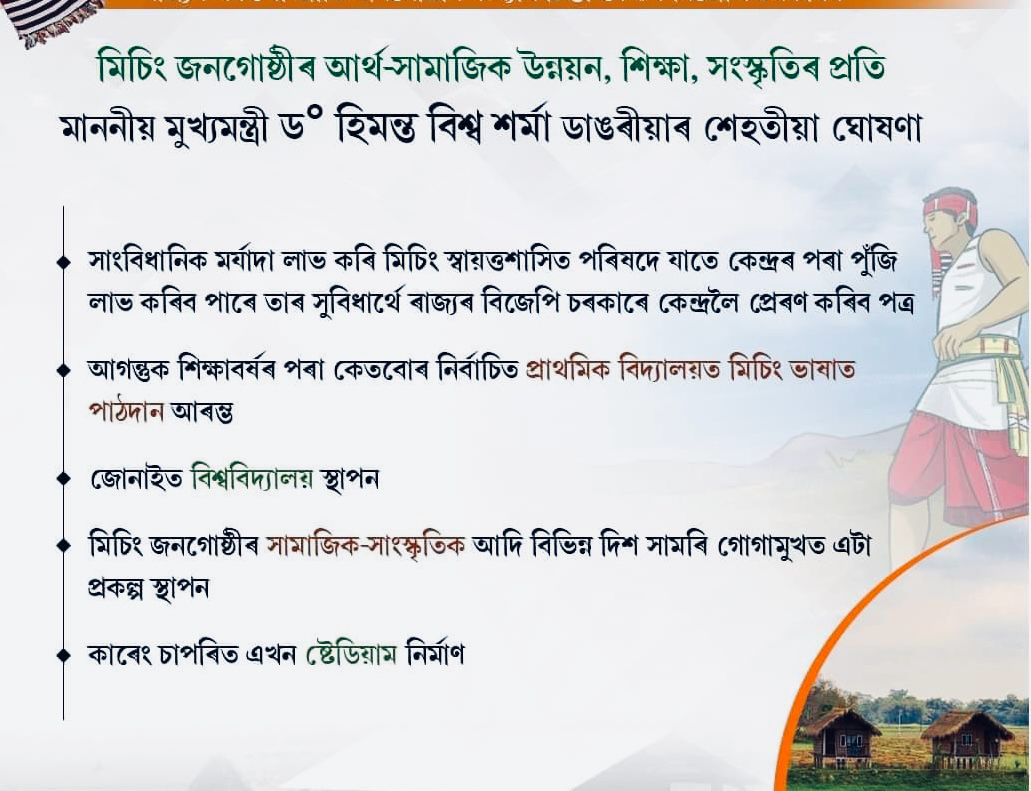
The state government has also introduced Mising medium schools in 200 primary schools across north and upper Assam districts keeping in alignment with National Education Policy 2020 which envisages mother tongue education for elementary education for holistic development of students. However, the real working of the medium of instruction is yet to be studied as it expressed that there were no appointment of teachers for the Mising medium integrated schools and training in pedagogical aspects to existing teachers. Besides, the number of schools is less given the huge numbers of Mising villages.

As the former Mising nationalist leaders have been fully co-opted and merged into BJP, the community rewards of being party to the power corridors was anticipated sooner or later by the people.
Issues of liberalized tribal belts and blocks in major Mising inhabited Jonai, Sadiya and Charikaria have been a matter of discontent among cross sections of people that include state and central government employees, lawyers, businessmen, teachers etc. The vulnerable riverine habitats and historical contexts of creation of tribal belts and blocks were ignored by the government. The Mising people have been worst sufferers of recurrent floods and river bank erosion. The relaxation of tribal belts and blocks are not applicable in other tribal areas of Bodos Tiwa, Karbi, Dimasa, Rabha and Garo. In fact, the talk of changes in tribal belts and blocks inflamed Bodo leaders and public before the BTR elections in September 2025. Although there is opposition from the Mising community on the relaxation of tribal belts and blocks, people prefer to remain mute spectators to avert political and personal reprisals. Besides, the sphere of voter influences and strength is limited in case of Mising people which is. not enough to deter government decision-making.
Although some families were rehabilitated by the state support, the full-fledged resettlement and rehabilitation of the people from Dibru-Saikhowa National Park continues to be a serious subject of human right of indigenous people. It exposes how the indigenous tribals are victimized in name of conservation.
The talk of autonomy within the constitutional framework is reportedly "under consideration". Union Home Minister Amit Shah has announced of appointing an interlocutors to discuss and deliberate with the Mising organizations at 10th Mising Youth Festival. However, the execution of the announcement is yet to be materialized.
The constitutional rectification of nomenclature of Miri to Mising is yet see the light of the day because the issue is not yet tabled in Parliament.
On the political side, the Delimitation of Constituencies by the Election Commission of India did not provide any reservation to Schedule Tribe in Upper and North Assam in both state assembly and Lok Sabha (Lower House ). The political strength of the Mising in terms of representation remained same as before like the Congress regime. In fact, the newly created Sisiborgaon assembly constituency came as unreserved constituency in Dhemaji district due to the relentless demand for open constituency. In Lakhimpur district, Ranganadi became an open constituency whereas Nowboicha was reserved for SC. The Lakhimpur Lok Sabha constituency saw Majuli assembly constituency was attached to Jorhat Lok Sabha parliamentary constituency. Thus, the chances of an ST being represented in Lakhimpur constituency are diminished. Since independence, there is no stable scope for ST representative in Lakhimapur parliamentary constituency. ST representation is limited to Karbi Angling-Dima Hasao (Autonomous) and Kokrajhar. Therefore, there is no voice of the Mising in Parliament of India.
There are requirements of quality infrastructure, proper access to education and healthcare in Mising areas. Seven decades of independence and participation in politics but still waiting!
Overall, the graph of the achievement of the BJP in terms of fulfilling the Mising aspirations is visible in the introduction of Mising language medium schools and decision of state holiday whereas in cases of land rights and security and political representations continue to be a cause of concerns.