Translate

Wednesday, August 14, 2013

An Adventurous Journey to Sadiya via Mebo- Namsing-Gadum

On July 20, 2013 early morning, Rhitu Kumbang and I set out in a car to the National Highway (NH) 52 from Annapur village of Misamora. Rhitu's plan was to dropped me to the highway to get me passenger vehicle to my home village.  The weather was pleasant with no sun rise in the morning, so he offered to take a drive along in the beautiful highway upon reaching Simenchapori.

While driving, I asked him what was the plan for the day where he replied there was no such specific plan as paddy transplanting was almost over in their family. So, my mind just played the idea that whether we should tour to Sadiya. Both of us had never been to there.  "Why not we take the car to there?" Rhitu exclaimed. But we did not had sufficient bucks. I countered how could he be so sure of driving the car to Sadiya since we did not had the knowledge of road condition. "Have not you listen oi nitom mentioning about Sumo-Winger vehicles plying to Amarpur, Sadiya? "

Sadiya is a historically significant place. From the chronicles, we come across in where Miri (Mising) tribe had raided and attacked in the territroy of Ahom kingdom till seventeenth century. With the advent of the British after Yandaboo Treaty, 1826, Sadiya had become a place of seeds of Tani languages and literature. British and American Missionaries left the place with indelible mark among the present Adi and Mising people. J.H. Lorrain's " A Dictionary of Abor-Miri Language" (1906) is the earliest ever lexicography produced in those times in Tani language. Other contributions includes J.F Needham's "An Outline Grammar of Shaiyang Miri Language" (1866), collection of folk story in Padam clan language. And in modern times, because of the inaccessible surface communication Sadiya was a safe haven of insurgent outfits where cadres moved around freely in island villages. Even red rebels are gaining ground as the media of late has reported. Many things were heard, never seen.

With all these exciting impressions in mind we plan to see the tip of Mising habitat, immortalized in many well-known folk songs in Mising society. We passed via the proposed Jonai campus Tezpur University in Majulipur village and reached our home. Rhitu and I had light breakfast given by Mom.

Then we drove to Jonai to meet Bhisma Doley, once a senior who now works in a college. We exchanged our car with his bike. We filled few litres of petrol at Ruksin and moved towards Pasighat.

Rhitu clean shaved and cut his hair in a salon. I bought some chocolates and chips in the town. We moved towards Mebo. We passed the beautiful Raneghat bridge over Siang. The highway was very clean with green forest on either sides with absence of man and vehicles. We crossed the famous knee-deep beautiful Siku river immortalized in oi ni:tom.
                                     
We reached an intersection where we found signboards indicating Mebo town. We asked about the route to petrol pump men in an fuel re-filling station. "You have to go straight to reach Gadum Tiniali. It is 58 kilometres from here. Amarpur is not far from there". (For details on driving direction from Jonai to Amarpur, please refer this link of Google maps. Also see text display .)

Then the adventurous journey begun! No village, no people, only thick forest! We rode along the unknown small metalled road with scary mind imagining of wild animals and robbers with sword!

There are few villages in between Mebo and Gadum namely Ngopok, Serum, Borguli, Namsing. And again, the imagery about these places is drawn only from one source--Oi ni:tom! We sung in the top of our voices with beating heart in the jungle road. We passed small wooden and iron bridges over streams and rivers.

We passed the Serum korong (literal meaning for river in Adi and Mising). We drank water of the river and also had a face-wash with cream. People generally speaks Adi language here, which is very much intelligible to Mising except the variation in tone. On  the hut shades in the river bank,  we saw a retiring middle-aged couple while listening to melodious old oi ni:tom of Kunjalata Kaman. When they came to know that we were from Jonai, the avid oi nitom listeners curiously wanted to verify a rumor from us, " Heard Tongki had gone mad, is it true?" (Tongki bi simad kang emna tattungai, arroi?). We smiled and told them that we did not know about it that we too stay in Guwahati although we belongs to Jonai.

We saw a group of damsels carrying a rifle most probably on their way to farm at Borguli. Rhitu and I did not dare to stare these damsels!

There are repaired wooden bridges. Local people who look after the bridges charges Rs. 20/ 30 from travellers with vehicles. The road where there are villages are stained with cow dung. Males are generally seen wielding dao as it happens to be a forest area.

There is a ghat after crossing Namsing. It is known as Taro-Tamak. We saw an old and long incomplete iron bridge stained with rust.

We reached Gadum Tiniali nearly at 1 pm. We looked for tea shop and found one where we ate puris as we were hungry served by a Gorkha woman.

We asked a couple on bike on how to reach Dotung ghat. People here generally tells travellers "Inde" (meaning there) when asked about distance to a place letting you presumed that it's  in a stone's throw distance! Actually, it is not the case exactly, may I provide you with a tip---it's not less than 5 km!

Gadum is a place with vast arable land with thin habitation. One would see stilted Mising houses with thatch roof in the country-sides in pictureque green background. We rode down from metalled road of Gadum to reach  Amarpur. You have to passed through chapori in muddy road. If you are lucky, you come across vehicles in the forest coming from Roing that passes via Dibang and Dotung ghats. Of course, there are cattle-grazers and cowsheds which is true of every chapori.

We crossed the Dotung ghat in country boat managed by local villagers. We went first to the famous Kedan Baazar where a weekly market is seated every Sunday. The bike was puncture just after crossing the Dotung ghat. It took almost two hours to find the small nail stuck in the back wheel by the mechanic and fix it back. This place of Amarpur came to prominence when the Takam Mising Porin Kebang (TMPK) once organized their central committee conference in 2008. Amarpur is an island and falls in Tinsukia district of Assam. The northern side across the river falls in Lower Dibang Valley district of Arunachal. The region of Assam is called Sadiya. It is said that there is no proper demarcation of boundary between Assam and Arunachal here. Land entitlements and permanent residence certificates keep worrying the minds of the people.  Both sides are inhabited by Mising people.

It was a sun set hour. We passed village after village in this unknown and new place to reach to a house we were looking for. When we reached, we came to know the person was not at home. We knew only one person in this unknown place, that too was not there! Rhitu was red-faced and I was speechless, we rode back via the muddy road and sat in an intersection thinking of where to proceed. In the twilight, we were left in a situation of --No Where To Go! To back to Jonai, there is the fierce jungle road. To reach the Chapakhowa town, we did not know the distance and possibility of getting ferry was thin! All our adventurous journey ended up in smoke!

However, we managed to refuge ourselves in an stranger's house near a lower primary school in the night!



Wednesday, July 24, 2013

Inside Arunachal Hill: Biking on the edge of river Siang

On July 18, 2013, Brian Orland and I rode off to Pasighat from Jonai, 35 km away from this small town. The day was drizzling since morning which delayed our planned timing by four hours. The previous night we had plan in mind to reach Amarpur of Sadiya and tried tracking the place on Google Maps. However, the rain gods didn't favour us in the following day.


Siang river
Biking on drizzling highway
After sipping coffee in a restaurant named 9 to 9 at Jonai town, we moved out slowly on a red pulsar bike at 10 am. We halted at Oyan to take tea.
Pebble pathway
All the way to Pasighat, we were seeing people busy in their farm work planting paddies in the field.

The highway was in developing condition, we had a challenging drive to our destination. At first we had our lunch near the forest check gate in this oldest town of Arunachal Pradesh.
Brian called up a guy named Omik Permey and sought his assistance to visit the villages along the Siang river inside the hills. Omik and his cousin came out.

Edging dangerously along the Siang

How far is China?
We crossed a check gate and drove along the newly constructed black topped concrete road. Locals warned us of possible landslides due to incessant rains along the under construction road.

We saw many tiny waterfalls along the way that were merging into mighty Siang.

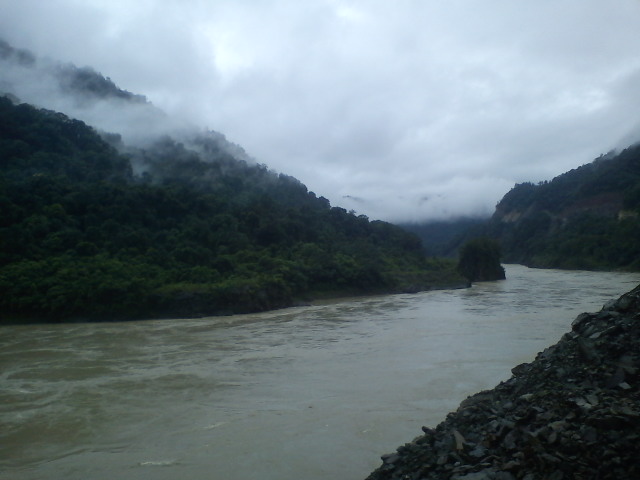
We travelled along the muddy road while having a classy view of Siang river and the thinly clouded green hills.

We stopped over at a rocky hills stretch of the under constructed road. It was a dangerous rock hill slope with constant chances of slide. After staying fifteen minutes or so, we saw pebbles rolling down the slope.

As soon as I heard the sound, I looked up to the slope. We all were fear struck seeing the pebbles that indicated of possible land slide.We were standing on the edge of river Siang. We immediately left the place.

At Bodak village and the land slide

We rode our bike up to Bodak village, a Padam clan rural setting of Adi tribe not far from the road and the river. We walked up to the house of head man, locally known as Gam. Brian and we all had a chit-chat with the head man on issues of development, economy, livelihood, and possible consequences of dam developing near their village. The head man's wife offered us tea and biscuits.
Clouded mountain

It was nearing 3 pm. We left Bodak. We were driving back to the down town. On our way back, we found the road being block by a huge pile of mud. We were told that just fifteen minutes ago the landslide had happened and the mud-removing vehicle will take 30 minutes or so to clear the road.

We waited for more than an hour. The mud was removed. We drove down to pass the Raneghat bridge and bade good bye to Omik and his cousin from the town.
Post-landslide

This one day monsoon drive was really a worth remembering experience in my life.

Saturday, May 4, 2013

Become a part of the Jonai Campus University Movement


Well, many might be interested in joining this social awakening movement for varsity that kicked off from small place called Laimekuri by villagers and rural college-goers and school-goers, but you might be far from your home village/ town/ state. 
Villagers and students during Highway blockade burnt tyres on April 29
 Take the example of Bikash Doley, a final year under graduate student of Laimekuri College, is consistently fighting for allotment of land for the project. He keeps updating his friends via Facebook on the latest development relating to this university movement. He shares pictures and information through social network that has indeed lit a tempo among large number of persons across the various walks of life. Bhupen Mili, a Phd scholar of IIT Guwahati, too has initiated an
Students forming human chain outside the Jonai administrative premises on May 3, 2013.


online petition for final approval of land allotment addressing the chief minister of Assam which have contribute to the growing awareness for the cause. There is still to do since the allotment of land is not final so far.


In this hour, what a concerned individual can contribute is by requesting the education minister of Assam, Dr. Himanta Biswa Sarma, through social media. Dr. Sarma is well connected on Facebook and Twitter. You can type or copy and paste/ message these words: "Sir, May I request you for speedy approval of land allotment process for Tezpur University Jonai Campus at Dhemaji district. " on his Facebook page ( http://www.facebook.com/pages/Himanta-Biswa-Sarma/329145898982?fref=ts) and Twitter handle (https://twitter.com/himantabiswa).

Become a part of the varsity movement. Please act now, time is running out!
 
Read more about the Jonai campus varsity movement: 
Lackadaisical Role of Administration Exposed
http://www.misingonline.com/tusikmassik/blog/tezpur-university-jonai-campus-land-allotment-sub-divisional-administration/
On Tezpur University land Allotment Politics
http://www.misingonline.com/tusikmassik/blog/tezpur-university-jonai-campus-land-clearance-crisis/
Protest demo in Jonai
http://www.facebook.com/photo.php?fbid=577464815619523&set=pb.104919259540750.-2207520000.1367732886.&type=3&theater 
Highway blockade in Laimekuri
http://www.facebook.com/photo.php?fbid=575809912451680&set=pb.104919259540750.-2207520000.1367732886.&type=3&theater

Wednesday, May 1, 2013

Brahmaputra river: Eroding Land of the Misings of Gohpur in Assam

I was in Gohpur's Mising villages on the day of Bihu this year. Towards south of National Highway 52 from Gohpur town in Sonitpur district of Assam, there are number of villages inhabited by Mising people till the immediate bank ( some are even after crossing it!) of Brahmaputra river.

We enjoyed Bihu with our friends based in number of villages, most of whom were in home during Bihu holidays. So far I can recall, the  name of villages we toured were Dondhi, Letburung, Choraibari, Lohitmukh, Pichola etc. Our gang of friends, most of whom were university students , when we reached Choraibari village, near the embankment joined local youths in merry-making . Some seized the cymbals, others picked the drums. Then, we were almost forced by a group of damsels to sing oi nitom, our folk song. We enjoyed in courtyard of taléng okum.

Portion of land falling into river Brahmaputra in Pichola
We were on bike. We rode through the muddy road cum embankment along beautiful taléng okum/ stilt house in the villages. A guy named Pabitra took me and another friend to the river side in Amguri Pichola near Lohitmukh. I was taken aback by images, a mighty river marauding people's dwellings and farmlands. I cursed myself I could not do anything to stop the beautiful land from eroding. We saw families packing their belongings to safer location with the increasing onslaught of the river. When many people are absorbed with Mising Autonmous Council (MAC) boundary and election,  I was witnessing helplessly shrinking land that falls in MAC. I am sharing the pictures which I captured with a friend's cellphone.

Women collects firewood from the river side.
This will be devoured soon, cause of people's silent weeping.
Can't we have a long term measure to stop erosion? What happened to the policy makers who promised of protecting the lives and property of people? Doesn't we have an engineer in the country who can make foolproof embankment rather than just sand filled long dykes? We can create billion of scams, not embankment. I'm sharing only these heart-pounding pictures , not the celebration ones in protest. This blog is dedicated to all struggling people of river banks who are serially been ignored, marginalized and excluded from the fruits of Indian democracy, whose votes are valued only during election.


I'm sure that no one will intervene or assist,  I will not see the river banks, the river side stilt houses, the green paddy farm any more when I visit next time. Because, this is Assam, and suffering people here are Mising!

( I am thankful to all my friends of the villages of Gohpur. Special thanks to Pabitra who took me to the river side.)
Sandcasting: This was once a fertile farm land and human habitat
"When we were in our childhood, we have to walk miles with packed meals to reach the ghat. Today, it is here".


Thursday, March 28, 2013

Easing Youth Unemployment in Assam: A Talk with Security Guard Trainees

Getting ready for drill

View from NH  37

Babul and me with boys from our place

            Babul and I went to see our village guys on the day of Holi festival to Agchia who were undergoing training program to become security guards. Since it was a holiday in IIT, we caught a bus to the place from Jalukbari at about 11 am. Reaching there, we were surprised to see many guys speaking our tongue housed in bamboo made single-side tin roofed camps. The camp where our guys were staying was bustling with oi nitoms on cell phones and some chit-chatting in slang-mix serious talks.

         We were welcomed by our boys with non-veg lunch. One cousin of mine quipped, " You guys are lucky that you come today, we have meat curry". We quickly ate the food which was served with two chillies. " Brother, we don't have enough water today", one of them rued complaining about the inadequacies of water supply even to take bath after playing Holi, the colour-soaking festival of India.
        After lunch, we all sat down in the bamboo made large-rowed bed. They talked about the rules and regulations during the training, of problems and prospects, their aspirations and future in Indian cities. One of the guys older than me from our village, an arts graduate replied me when I asked him why had he come here, " No deal eh! I"ll go to Paresh Baruah (of Ulfa) after completing my training here. We have learned everything now except firing guns!". His nickname is Rabon.

        During our childhood days, we used to sit in circle at a roadside village ground in the evening and sung hit Adi and Galo songs( "Sai sai sina was one!)clapping like an orchestra. Since our villages lies in the border of Arunachal, we have had natural inclination to learn song and language of the other side. There were many elders in our village who could speak impeccable Galo tongue and used to kid us with new lingo. Rabon was one who once led us introduced to the world of neighbouring cultures.
            I knew Rabon was kidding about Ulfa and he revealed us later that his elder sister who was recently married off have sent him to attend the government initiated free training program after selling a big swine. " You know my old mom is alone at home now, they are concern about my future so I came here. Otherwise, I would have gone fishing in the ponds today if I were in village". The guys from our place told us that there are highest number of trainees from Dhemaji district. " There is an Assamese guy, you know he is a head master's son from Silapathar and he is a graduate too. His elder brother is also a TET teacher.  If a person from his background can come, why not guys like us who have nothing at home". " This is the last ditch attempt to build my life. If I can saved money for an auto-rickshaw after my employment as security guard, I'll return home soon."
            We discussed many things what others may just consider as crap. From the talk of campus varsity at Jonai to politics: Sixth Schedule, MAC elections, unemployment and nature of village youths.  Some younger guys immediately left our crap talks when it was alerted from the threshold that girls were coming.  A guy facing towards me said, " Arope biro, ko:neng kangkikuma:nam bojeko idakbo, ngo ka:po:ye!" (Really brother, I have not seen girls for days, I am going out to see!". " I don't know why they are so crazy, can't they have patience for 35 days without seeing girl", one of them mumbled. I know the boys were desperately missing their rural environment here.
                I asked one of my cousins, "What about your study? Did you left?" " They will let me appear in class 12. My parents have allowed me to come here", he replied. Rabon added that my cousin was having his class 11 exams, he left it and come. Rabon said, " It is good that he join us. Otherwise he have been taking dendrite and grass there. He was narrowly  restored from the drug gang. All sorts of intoxicant stuffs have ruined our village boys these days. Those who have stayed back are doing nothing except playing cards, drinking and bringing bride. At village, you know you ate your food and wander without work whole day. Here at least, government is providing everything from food to uniforms, we are learning something for our lives too".
             More than four hundred youths from various districts of rural Assam are undergoing training program for private security guard under the aegis of government of Assam's Employment Generation Mission at Agchia, about 35 kms from Guwahati. The training program is provided free of cost for 35 days which includes physical fitness, discipline and regulation, fire fighting techniques etc.  
           They are being trained by ex-Indian army. The initiative is taken by government of Assam in order to minimize burgeoning unemployment in the state. The minimum education qualification to join this program is matriculation. 
             @ All photographs are courtesy of Babul Doley

Friday, March 1, 2013

Ali-A:ye Lígang Longédok Dairi


February 13, 2013: Ginmur po:lo a:la asinang okanodo:pé ésar sarradungai, pítír kurak la dungai daggabnam amo:dé. Luki ésar sarra anné kaman  ísíng amíng kídídém moyo sula dung lambé kéra do írga:né lutadko bombi dungkunémpé. Singgi appun punna lí:jík lí:jík pé appíloi  ka:po la dung.  Koka dokkémpé tagad appun punamém kabek tokuma émdaggom, silo-mélo tagad amingém bojéko ka:bekma. Lígang sém borík supé okoiko pí:ram dagnémpé ila dungai.

Tako Gí:tu dok Mé:mipénam Dírbí Karé

Suk bírduk so ngo do:lupé gíkaku  Ali-A:ye Lígang (AAL) kangkolo. Dítak kínít ko ikangaboi ngok sí:sang ko do:ludo Lígang kangkima:namé. Tiket pa:ma:la Guwahati Inter State Bus Terminus (ISBT) dokké Laimekuri pé Assam Valley  baslo kebin ara:do tetmíndanna gíku.  Okum érang tani odokké ajon-arum lédulo gí:dí-sípí ém ka:pé émna toktoku IIT Guwahati dok mélík (leave) langge:la.
Rokom kínít anin ayirdo bas lokké gíy danna  ngo Tako Gí:tung LP  school lotta do dírbí iko karéko ka:bekto. Lígang longai odo, tetgéng (chair) ém bojéko pa:sala létak. Bagémpé méngkang, “Arey, okai dírbí léngkan kane méyum? Okkan sé bulu, Lígang sé sémpéi ikangkun su!”
Akula du:né poka lamtédok do:lupé alé daman daman la gíku kabeknam karédo agom mé:mila. Lambédo ajon Natukali, Tanibhai bulum ríksuto. Kangkinnam taniyém ríksunamdéméi  aidun-aiman émna tatbomla-tatbomla okumpé pí:toku.

Bulukangké Lígang Dumdum Manbonam Do:ying

Ngoluk do:lung so:man....
Do:lu lok sí:sang odokké abín kídídé AAL légang ager gerra dung rokom dokké, okolai maik lok bottapé oi ni:tom manla dung kéréng-kérénglo gí:tung-jikong kinma:pé. Ajon-arum ém phon ila do:lu do ngolu ríksumínsutoku. Longédo do:lu do Líggod ém ka:pé émna asinsokki tarung dém ru:to. Poridung émna éddí dítakko do:luso kangkíkumang, silo dan ka:pébong. Kindagéipé migomésin Lígang anino:lo ankang tarungé ru:dak émna.
Longédo aso aso:pé tanyi yatkumsudu:bo do:lung dírbí lottadop. Ya:me-mímbír, milo-yaméng, miné-míjíng géru-bomru sula takam gíngab du:bo. Kajé irobla:boi émna sékai-sékai jé:bom du:bo, yummayiryé sémpé il du:mílo, édílo soman-yirmanyén, édílo doman-tímanyén?
Dum dum lu:pi manrob la:boi émnamé, dum dum mankin né tani kama, Líggod kapé iyén? Ya:me ko kídísok sékosinne dumdum mankinné katoman émna sékai abín taniko sékomsin suttékmap apping tatdop ge:dung. Mankinné ngoluk ta:to Digholangkésin alak ser dung, supak sék manboyan?
Odo ayirdo Buluka émnam míjí dém sékai mé:pa:to. Élo, Buluka bí Líga lo do:lu so lendagada, su okolan?  Tatgonammé lubidak Lígang longé lok mé:panam dum dum manjo:né ta:to Bulukabí ríkkong ké do:lung ko:lo manboka ro:do, odok lédupé kekonké doludém manbola dung.  Édém manaboge:la:pak ngoluk do:lupé gísa:yé. Lunamí démpé lédupé bí  gído, odokképak dírbí lotta dé írgangkang.
Ko:ka dokkébo ka:tak  Buluka ta:to bím, ru:be dak émna de:gé dolung amme lukadak lékom lamté-béda:lo. Yamné kamang . Amilo pagbo kísapé gerra aíké donamém bí la:len sudak. Émmum taniyé dítak dok angu longé kídído, émpigel bí ma:mílo ngoluk mé:bomsunam dírbí tarungé ingabla:ma. Aro:pé mé:yém, réngam ara:so Bulukang kémpin dírbí migang éddík du:song? Dumér ako sékai édílai tulík kítan?

Oi ni:tom, lotta so:man élang baik pamsarnam!

Yumé ayirdo do:lung ajon lédulo ngo:sin apong tínggo-dogo mannam taru do a:mínto. Do:lung ajon émyém yamné la:no ngébo abayang, akelokké obo akosin idu:bo! Okumbomna dola du:bo ngok sí:sa jonsunamé supak, lékom ngo okkom il dun émna mé:dak! Porila dungkolo sémpé idakbona émna  mé:yin sula du:doku!
 Oi ni:tom, kaban sékoi okkom pagdakji moset-moret bomdanna okum okum lo ír bola dungai takamé, sékai odo ara:do modagai ngok tatkí ma:nam oi ko sémpé: O: bí mé:nam do gíge:la, Bau bí mé:nam dém langge:la, kapila ngom lutum dun ngokké oi mé la:pé mé:dosom, O:bí sí:sang ayir pangkar ma:némpé, Bau bí sí:sang ayir gibadar kímanémpé...
Yirman-soman ara ngí:do ngokké Koton Kolej do po:pé ké senior akolok phon angkang. Bi ngoluk do:lung kérangíng kolo dung lotta soman ka:la,ngom ríksu:yé émdak. Facebook do AAL yalo update lok ngo gísa dungku émnam kinla nombor dém amikolok magabgel phon dung émto.  Oh! Technology lok tani okol duji édémsin an-gab la:named  vmmumémpé ikangku  émnam dém aropé kinsék suto odo.
Ngolu ríksula kekonké do:lung do mibo ya:me émsula ba:pi-bangok oi ni:tom moto. Koton Kolej dok hostel du:do dokkém ngolu mé:pa langkula Disangmukhoi Ophola démsin paklíktoku!
Jonai  pé yumé do gísané senior annyi lédulo, lékop dulangkui émna.  Junkaréng ruyi do baik pamsar kang kinso:map. Tolopésin mo:tédak, bolopésin mo:tédak, NH 52 do ngolu kapiyen  supak?  Beteri kéik la du:ne ngok mobail so ayir dém ka:toném  10.30 dakbo. Ajon-arum ém phone ila du:dom Maruti 800 kar ako duksa:do, ngoluk  lambé ríson dok dakla du:nam dém ka:la sékai gari ara:dokké amin ako jénggel du:tet kang. Ka:toném ngoluk ajon Dhononjoy Modi ké biro lok ajon appiko dung, bulusin Silapothar bokké Lígang dogel gídungku. Gepla du:né gari ara:ngí:do ngolang ajon ako dura mínto, Bhismo bí baik dém atér dé kapéi daggom dukbomyéku émnam dém togésukang.
Yumédo Jonai dok Bhaskor Tayeng, odokké ajon Mintu Régon annyi dé pongkokdokké dukríksula pí:toku. Ngasodlok pa:nam dé:pak aro ajoné!

Ali-A:yé Lígang  Borík Yumdéng Agom

Jonai pé pí:salangkula Lí:sang do:lung pí:né Bhismo ké rumdo:pé. Mimak moné ajon Mintu Régon mé  ríksula  Jonai modi dok ‘latest update’ tatka. AAL soman-yirman mépakge:la ngolum gíríksukol gínamdém bí lugela sémpé gompir ékké pirsarto. Mg. Régonbí  suk  dítak sokké anu dírlab ko la:len dung émnamdém kinmoto.
 Do:lung-lujar takamlo Ali-A:ye Lígang boríksunam tarung ko igurbodung, okkon émtoném “Ali-A:ye Lígang Borík Yumdéng” (AALBY) émtak. Yampo Lígang émdo yumédo réngamé (ya:me-mímbír!) AAL ém ír-pongkír pé ager-atung gerla, gumrag soman-yirman, purang apin, ambuk atí-atí amanla du:dope édé taru dé. Pagmílo karé mosa danna mojo-molabné ni:tom tuli gokla AAL kangkanpé borík sudopé idung.
Mg. Régonké lubidak lédup kinsékto Tako Gí:tung dok dírbí karédé oko légang motagaji! Takunammé ni:tom tuli Toraboti Bori bí:lang Sorbeswor Kardong bí gídagai émdak méyum, kinnoyamílo kangkol gísangkupé nammai! AAL borík yumédé éddíko ngoluk sí:sangém  Oang Dírbí (Western Culture) mé:bonammém motum layén édémpak mé:mipénamé, tatge:la mé:to.
Ayirdém ka:namé yumé 12 yébo. Aíké du:télop ainé yumé émgel gípan sukuné.


Thursday, February 21, 2013

Politics of Consensus: Debating Mising Autonomy


This article appeared in Seven Sisters Post, February 19, 2013, Guwahati. If readers find difficulty in reading , please visit http://mishingrenaissance.blogspot.in/2013/02/politics-of-consensus-debating-mising.html

Wednesday, January 23, 2013

Akademi winner Chandana Goswami writing novel on Mising migration from China

Luoba people of China have Mising connection.  Photo: CRI
Sahitya Akademi winner of 2012, Mrs. Chandana Goswami, who is obsessed with historical fiction, is focusing on Mising people's migration history to complete her upcoming novel. She told this to Times of India in Guwahati recently.

Mrs. Goswmami won prestigious Sahitya Akademi award for her debut novel "Patkai Ipare Mur Desh", a historical fiction, which was based on Ahom dynasty. According to an interview published in TOI, she has already visited China for the purpose. "This time I will focus on the Mising tribe and their migration to India. I have already visited China for my research study. I met a Mising woman in 2009 who gave me the idea. I had to study the history of Tibet as well", she told the newspaper.

Mising tribe, also known as Miri, are second largest ethnic minority group in Assam along with about 20,000 population in sparsely inhabited Arunachal Pradesh. They belong to Tani groups of people, who shares ethnic and cultural affinities with Adi, Galo, Nyishi, Apatani and Tagin tribes of Arunachal, the frontier state which is also claimed by China.  They are also linked to Luoba ethnic of Nyingchi Prefecture of Tibet Autonomous Region (TAR). In July, 2007, China Radio International (CRI) reported about Luoba people presence in Southeast Tibet. CRI said in their website, "In the deepest forests of Southwest China's Tibet Autonomous Region live a group who call themselves the Luoba People. Scattered primarily throughout the Luoyu Region of southeast Tibet, the Luoba, with a population of less than 3,000, are the smallest of China's 56 ethnic groups. Today we are going to walk into a Luoba village and meet the people there - who are connecting more with the outside world".

It would be noteworthy to mentioned here that the Mising people do not have historical records of migration. They speak their own mother tongue with the same name. However, it is clear that migration in the historical period took place once from parts of present day China. Their connections to Pemako or the Shangri-la, Koje Pa:tang (according to the tribe) or the Kailash Mansarovar, presence of Tibetan/ Chinese beads and ornaments like dogne and tadok, use of cotton woven blanket Gadu or Mirijim , life style of stilt houses etc. among the tribe gives a strong basis for an insightful research that could be shaped in the form of systematic stories or novel.

Her upcoming novel based on Mising people and their migration has serially been publishing in an Assamese newspaper's Sunday supplementary called Hombhar of Asomiya Pratidin. The novel is named Kéyum.

Thursday, December 6, 2012

Riots, rumors and mass exodus

Guwahati: Bhasker Pegu, age 23 years, is a research scholar at the IIT in Guwahati. He belongs to the Dhemaji district of Assam, located on the Assam-Arunachal border. Mr Pegu has been living in Guwahati for the last six years.


The spurt of killings which began in Bodoland autonomous region of Assam in North-East India and spread to many regions of the country, has been dubbed as India's biggest-ever internal displacement so far.

This cycle of violence unleashed a collective insecurity as the fear of retaliation gripped the psyche of North-East people, especially people with Mongoloid features residing in South and West Indian cities. The outcome is the mass exodus to North-East India. While the Centre and Indian media squarely blames Pakistan and technology-driven rumours, propaganda and social media, we cannot deny the existence of conflicts due to the socio-cultural diversity of Indian society. Rather than blaming much on Pakistan and technology, we must also know the wound in ourselves for the recent exodus and violence. We must realise the fact that the current situation has much to do with the democratisation and consolidation of ethnic, religious and racial heterogeneity of Indian society.

For close to two centuries, these people with Mongoloid features, lived in the wilderness with their tribal chieftains with sporadic wars within the region. In 1826, the Treaty of Yandaboo ended the first Anglo-Burmese War and brought about peace in the region.

Today, they are suddenly caught between the hate and violence springing from religion and politics. A call from a friend of mine belonging to the Mising tribe, the second-largest tribe in Assam, got me thinking about the issue of the ethnic violence between the indigenous tribesmen Bodos and immigrant Muslims. He is a higher-secondary dropout from a government school located in rural Assam and he went to Bangalore six years ago to seek a secure livelihood as Bangalore is known as the I-T city offering much-heard-of employment opportunities. His panic-stricken voice over the phone on the eve of India's 66th Independence Day, was indicating the fear, insecurity and deep concern over the current situation of Assam. My response was that the situation has almost returned to normalcy in lower Assam in order to pacify his fears of a large-scale conflict. Many of us who reside in a culturally-diverse country fail to understand the unique identity of various ethnic groups. Many ethnic groups in North-East maintain their status quo, their exclusive identities.

I was perplexed to hear from him that he and his North-Eastern friends lives are in 'danger' and they were looking for tickets to return. However, the efforts were in vain, so he sought our immediate assistance to arrange train tickets for a safe return before the "deadline August 20" approaches. I was extremely concerned about the safety of the innocent people who would bear the brunt of the conflict.

So, I tried to clarify the details on the threats faced by the North-Eastern people in West and South India but the people were clueless about the origin of the threat calls. I also took the pro-active step of communicating with the public leaders of some organizations in Assam through mail.

At 7:00 am on August 15, 2012, my friend apprised me of the confirmation of their return tickets. Around 8:00 pm, he reached the railway station and was shocked to see the masses of people planning their return to Assam by the two additional trains provided by Indian Railways to ease the rush of people. In the intervening night, I saw the news going viral on social media (Facebook and Twitter) and various news portals. I had commented on a news portal in the forenoon as a reaction to Prime Minister's speech on security and later during the night a follow-up brief blog on a community networking site.

In the wake of debates on violence and mass exodus that sparked off from a small region of lower Assam to many parts of India, what is more crucial at this hour is mending our ways of perceptions and stereotypes that is entrenched in the Indian society. People from different parts of India settled elsewhere besides their homelands are more or less prone to social abuse in day to day life. This is evident from the 'chinki' tag accorded to Mongoloid-looking people in various cities of India. While acknowledging this, we must also know what is the enormity of stereotype within Assam or North-East India as well? How many of the legally settled immigrants of East-Pakistani origin are stereotyped as Bangladeshi nationals in social life, not just by people but in media too?

The tensions between indigenous Bodos and immigrant Muslim settlers in lower Assam also extended beyond Assam to affect other North-Eastern states and those with Mongoloid features from Darjeeling. They too felt the pulse of insecurity and exodus.

Many prominent political figures including the chief minister of Assam have conceded that porous borders are the root cause of recent violence and displacement. What is more questionable is -why not strengthen land laws in the state to leverage the safety and security of the indigenous peoples? It has been suggested by many intellectuals and scholars since many years that work permits should be alternative measures to discourage permanent settlement and land entitlements, when it is established that illegal influx is deeply rooted.

While it must be accepted that unity and integrity of nation is at stake, as the Prime Minister himself had said in Parliament, the social understanding and tolerance among the people of India irrespective of race, ethnicity, region, culture or religion are only the way forward to instil an atmosphere of peace, security and stability to a nation celebrating the 66th year of Independence. The democratisation and consolidation within diverse sections of Indian society is the call of the hour, rather than putting the blame on Pakistan and social media. The roles of social organizations and political parties must go beyond their political imagination of electoral calculus as the integrated nation is much more significant. This can be achieved by keeping in mind the interest of unity and integrity at zenith. The sensible role of local media and leaders is equally called for in Assam. That will certainly pay dividends in bringing peace and stability in the communities.

"What are you going to do back at home?" I raised the concern over the future scope of my friend in Assam who was one among the people returning from Bangalore.  There was an eerie of silence from his end, "That is what I am thinking now, to engage in agriculture... the season of cultivation is also over". This is where the reality lies, the common people are sufferers of the day in the midst of information asymmetry and falsification of facts.

Source: http://www.ndtv.com/article/india/blog-riots-rumors-and-mass-exodus-258023

Government notification regarding state holiday of Lígang

The state government of Assam officially notified gazetteer full holiday  of Ali-aye Lígang in March 14, 2026. This came after the cabinet d...