Translate
Thursday, March 19, 2026
Government notification regarding state holiday of Lígang
Wednesday, March 11, 2026
Ali-aye Ligang as state holiday: Delight and discontent of the Mising
The Assam cabinet decision of state holiday on Ali-aye Ligang, a longstanding demand of the Mising tribe, has received a mixed reaction from the society. While the Mising people at large across the state are jubilant with the cabinet decision of the BJP-led government, some are critical about the decision being taken before the forthcoming assembly election as the Ali-aye Liagang of the current year is passed in February 18, 2026. Ali-aye Ligang was, otherwise, a holiday in 11 districts of north and upper Assam and restricted holiday in the rest of Assam. The cabinet of Assam government headed by Himanta Biswa Sarma took the decision on March 10, 2026. Therefore, the decision will be effective from 2027. The closing session of Assam Assembly on February 18, 2026 witnessed a heated exchange between Jonai legislator Bhubon Pegu and Sivasagar legislator Akhil Gogoi over the issue of state holiday. Nevertheless, the government has fulfilled a longstanding aspiration of the Mising and paves the way for statewide recognition of the Ligang festival. It is an acknowledgement and respect for identity of Assam’s indigenous people and its diversity.
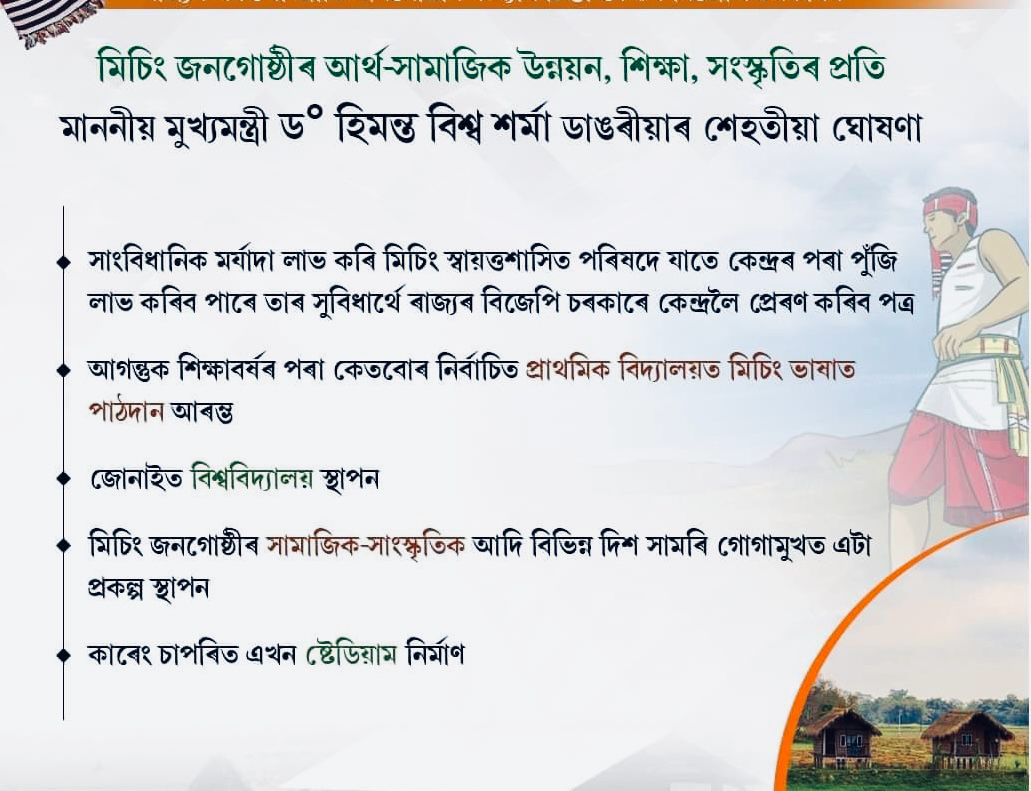
The state government has also introduced Mising medium schools in 200 primary schools across north and upper Assam districts keeping in alignment with National Education Policy 2020 which envisages mother tongue education for elementary education for holistic development of students. However, the real working of the medium of instruction is yet to be studied as it expressed that there were no appointment of teachers for the Mising medium integrated schools and training in pedagogical aspects to existing teachers. Besides, the number of schools is less given the huge numbers of Mising villages.
As the former Mising nationalist leaders have been fully co-opted and merged into BJP, the community rewards of being party to the power corridors was anticipated sooner or later by the people.
Issues of liberalized tribal belts and blocks in major Mising inhabited Jonai, Sadiya and Charikaria have been a matter of discontent among cross sections of people that include state and central government employees, lawyers, businessmen, teachers etc. The vulnerable riverine habitats and historical contexts of creation of tribal belts and blocks were ignored by the government. The Mising people have been worst sufferers of recurrent floods and river bank erosion. The relaxation of tribal belts and blocks are not applicable in other tribal areas of Bodos Tiwa, Karbi, Dimasa, Rabha and Garo. In fact, the talk of changes in tribal belts and blocks inflamed Bodo leaders and public before the BTR elections in September 2025. Although there is opposition from the Mising community on the relaxation of tribal belts and blocks, people prefer to remain mute spectators to avert political and personal reprisals. Besides, the sphere of voter influences and strength is limited in case of Mising people which is. not enough to deter government decision-making.
Although some families were rehabilitated by the state support, the full-fledged resettlement and rehabilitation of the people from Dibru-Saikhowa National Park continues to be a serious subject of human right of indigenous people. It exposes how the indigenous tribals are victimized in name of conservation.
The talk of autonomy within the constitutional framework is reportedly "under consideration". Union Home Minister Amit Shah has announced of appointing an interlocutors to discuss and deliberate with the Mising organizations at 10th Mising Youth Festival. However, the execution of the announcement is yet to be materialized.
The constitutional rectification of nomenclature of Miri to Mising is yet see the light of the day because the issue is not yet tabled in Parliament.
On the political side, the Delimitation of Constituencies by the Election Commission of India did not provide any reservation to Schedule Tribe in Upper and North Assam in both state assembly and Lok Sabha (Lower House ). The political strength of the Mising in terms of representation remained same as before like the Congress regime. In fact, the newly created Sisiborgaon assembly constituency came as unreserved constituency in Dhemaji district due to the relentless demand for open constituency. In Lakhimpur district, Ranganadi became an open constituency whereas Nowboicha was reserved for SC. The Lakhimpur Lok Sabha constituency saw Majuli assembly constituency was attached to Jorhat Lok Sabha parliamentary constituency. Thus, the chances of an ST being represented in Lakhimpur constituency are diminished. Since independence, there is no stable scope for ST representative in Lakhimapur parliamentary constituency. ST representation is limited to Karbi Angling-Dima Hasao (Autonomous) and Kokrajhar. Therefore, there is no voice of the Mising in Parliament of India.
There are requirements of quality infrastructure, proper access to education and healthcare in Mising areas. Seven decades of independence and participation in politics but still waiting!
Overall, the graph of the achievement of the BJP in terms of fulfilling the Mising aspirations is visible in the introduction of Mising language medium schools and decision of state holiday whereas in cases of land rights and security and political representations continue to be a cause of concerns.
Sunday, October 6, 2024
Why Mising Autonomous Council is in the news again?
Thursday, April 11, 2024
Thursday, December 14, 2023
Talks with state government on Mising issues by TMPK, MMK, TMMK
Monday, June 26, 2023
Draft Delimitation, 2023 of Assam: Mising and other tribes may become politicaly insignificant in days to come
Tuesday, May 30, 2023
Mising language in primary schools: But when?
Thursday, November 10, 2022
Monday, May 9, 2022
What is ailing the Mising language?
Sunday, October 24, 2021
Jonai dok tribal belt éla block mopen namdé kémo lo:pé ní:líknammé
Monday, March 15, 2021
End of road or era of new beginning in Mising ethnic politics?
The need of addressing the fundamental Mising aspirations
Majority of the Mising public are in the dark about the terms and conditions of the sudden shift. As the key issues of Mising aspirations are not yet addressed, there are concerns of loss of cultural identity and potential threats to language, customs, tradition and resources in the absence of independent political assertion.
The talk of granting constitutional status to tribal autonomous councils including that of Mising Autonomous Council of Assam at the peak of anti-Citizenship Amendment Act movement is nowhere to be seen in the political theatre now. The big dream of achieving Sixth Schedule under the Indian Constitution today is gradually dying down. Of course, it is claimed that the current phase of political alignment is part of the process of ethnic movement itself.
Flood and erosion are one of the prior concerns of the Misings. This perennial problem has triggered displacement and conflict in various parts of upper Assam districts. Natural disaster based internal displacement should get priority in resettlement and rehabilitation agenda. It is compounded by conservation based displacement and worries of eviction from their traditional habitat. In the name of wildlife conservation and expansion of protected areas especially the Kaziranga National Park, it is observed that Mising people of Gohpur and Bokakhat are one of the foremost sufferers. There is need of reviewing the current conservation approach followed by the government that constantly keep indigenous people and forest dwellers under threat of eviction and forceful relocation. There are also demands for Poba reserved forest of Jonai in Assam-Arunachal border should be declared as protected areas. However, from the evergrowing experiences encountered by the people, all these matters need to be carried forward to environment and conservation policymakers of the country . The grievances must find solution. People and conservation must co-exist, they should not be mutually excluded.
In the cultural front, the demand of state holiday on Ali-aye Lígang could not be realized even after years of movement. In the context of development of language, the issue of medium of instruction in mother tongue in Mising inhabited areas in primary schools are not yet addressed. The New Education Policy, 2020 has been welcomed by Mising organizations as it automatically stressed on providing education in mother tongue in primary level. However, given the scenario of language politics prevailing in the state of Assam, the introduction of such language policies will face challenges. Key Mising inhabited area lacks a full-fledged university or a medical college. A proposed campus of Tezpur University which was to be set up in Jonai did not see the light of the day even after years of donation of land by local people. While rehabilitation and land crises are on the rise among the Misings, the Dibru-Saikhowa National Park residents are yet to be fully addressed. Vast majority of people does not own land entitlement certificates. Forest land inhabited by Misings should be dereserved and be accorded as habitat tag.
In the southern bank of Brahmaputra river, the riverine belt from Kaziranga National Park to Bogibeel bridge communities live in pathetic condition in terms of road and communication. Majority of the Mising inhabited river bank areas live a challenging life in monsoon season in districts like Jorhat, Sivasagar and Golaghat. There is a need of attention from policy makers to improve the infrastructure along the river bank to ameliorate the miserable conditions. Raised platforms for cattle are required more in the region. Embankment built in the river bank should be transformed into a highway for better communication in order to address the communication bottleneck beginning from Kaziranga area of Bokakhat to Bogibeel bridge after proper scientific study.
Will national parties be committed to Mising aspiration?
The fundamental aspects of Mising aspirations must be addressed at first while the quest for power and influence might continue like any other politicized ethnic groups. Otherwise, the remnant of ethnic mobilization will not decompose easily even after capturing power in the future. It will, of course, satisfy a section of clietilistic network of followers but collective benefits in the form of public goods cannot be accrued for the community at large. This assembly elections of 2021, for Misings, is nevertheless a new beginning in political participation of the Mising nationalist path. However, common Mising public will wait and watch whether the national parties honour with commitment to the fundamental aspirations of Mising tribe.
Saturday, December 21, 2019
What is the Constitutional status for Misings and other tribal councils of Assam?
Saturday, April 27, 2019
The Conservation Discourse in Assam must Consider a Sustainable Rehabilitation Plan for the Mising Tribe
The Misings in Upper Assam continue to lose most of their arable territory to constant floods, forcing the affected people to look for alternate living spaces. Often, they find themselves occupying land in protected forest areas, leading to conflict and opposition; both from conservation groups and the local population of the region.
Read more : https://www.epw.in/author/bhasker-pegu-and-manoranjan-pegu
Monday, February 26, 2018
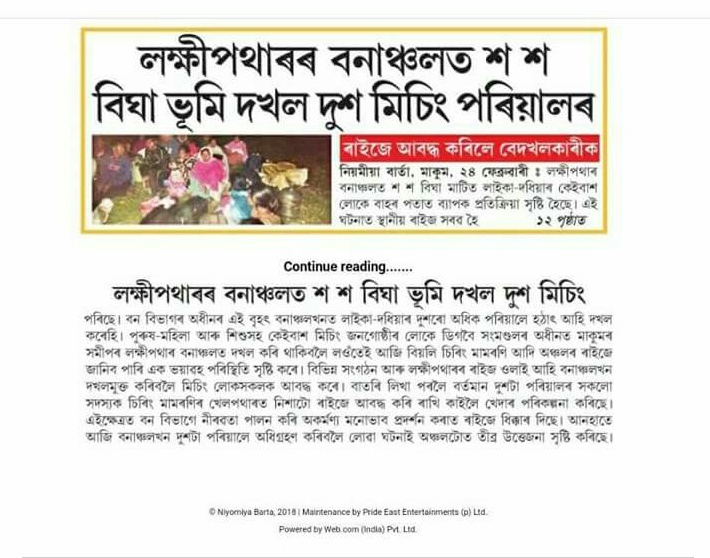
Disparaging content in Assamese dailies on the plight of Mising tribe
Apparently, the government has failed to rehabilitate the suffering people that has compelled them to look for settlement in forest areas in their own. On July, 2017 there was written understanding between the representatives of Mising student union TMPK and the government authorities that the people would be rehabilitated in eight months after similar events erupted in the district.
When even illegal migrants cannot be expelled forcefully by the state but have to follow the procedure established by Indian laws, it is quite disheartening that marginalized indigenous tribe like Mising are accorded with partisan and contemptuous words in the heights of plight in the Assamese language press. Flood, erosion and legal restrictions in National Park have already crippled the Mising tribesmen but some Assamese language media who are dominant in Brahmaputra Valley are celebrating the sufferings with their disparaging and vexatious content devoid of public responsibility and civility. It is no less than adding salt to the wounds.
One can find the proof of content published in Assamese dailies: Niyomiya Barta and Dainik Janambhumi on 25 and 26 February, 2018.
Read more on the plight of Mising people:https://bhaskarpegu.blogspot.in/2017/08/the-selective-silence-of-civil-society.html?m=1
Tuesday, August 8, 2017
The selective silence of civil society and sufferings of indigenous Misings in Assam
![]() |
| Although Assamese dailies does not provide eye-catching front page headlines, they cared to publish few news items in the inside pages about the sufferings of indigenous Misings. |
5. Encroachers re-occupy cleared land in Namphai RF, arrested, The Assam Tribune, August 8, 2017
Monday, June 12, 2017
Citizenship questions and inter-ethnic relations in Assam in context of Silapathar incident
![]() |
| Source: Tani Agom Ésar, Guwahati, Mising-Assamese Bilingual fortnightly, June 1, 2017. Language: Mising/ Tani |
Wednesday, April 19, 2017
Atrocities by immigrant Muslims on Mising tribal in Assam
![]() |
| Asomiya Pratidin, April 17, 2017 |
![]() |
| Source: Amar Asom, 17 April, 2017 |
![]() |
| Amar Asom, April 18, 2017 |
![]() |
Wednesday, April 5, 2017
Hegemonic nomenclature over ethnic minorities' place in Assam: The latest example from Indian Railways
![]() |
| The railway notification for the nomenclature. Source: NFR/ Facebook page |
The Kamakhya-Murkongselek Intercity Express that was started in 2015 after a gap of decade due to conversion to broad gauge (BG) brought many cheers to the people in upstream north bank of Siang river, the region characterized by underdevelopment and non-industrialization in Assam. Being inhabited mostly by tribals, it is one of the most neglected region in the state. Silapathar, which is in the same region, was recently in news due to the attack on a local office of influential student union by supporters of refugee rights body.
The train to Murkongselek, which was once a part of North East Frontier Agency (NEFA) now Arunachal, was introduced post-1962 Sino-Indian war as metre gauge (MG) line in 1976. The foothill Mising inhabited region was clubbed under the "Excluded Areas" (Sadiya and Balipara Frontier Tracts ) in the colonial British period that followed restrictive intervention in interaction and policy matters and total exemption from provincial laws unlike the other plains part of Assam.The then MG train was named Arunachal Express. But, what surprises many in recent times in greater Murkongselek region (also known as Jonai) is the Indian Railways lack of demographic and cultural sensitivity after the introduction of BG line. Without any consultation with any quarters, the train was named via notification in March , 2017 as Lachit Express, which has no cultural resonance with the place. The Mising people, who are otherwise the second largest tribal group, having their own language and culture, came under the grip of hegemonic project adopted by ruling elite's parochial nationalists. The Mising has no influential and conscious leaders in the political quarters which could had exert influence or offer resistance to such chauvinist policy. There has been many trains running from dominant Assamese elite belt such as Tinsukia, Dibrugarh, Guwahati , Kamakhya which are also a developed and industrialized region located in the south bank for many decades almost to all parts of India. The majoritarian communities has produced influential leaders who has enormous say in policy matters of Assam since the post-independent period. There cannot be just one but ten of trains named after the great general Lachit Borphukan. But it remain a questionable policy as to why the north bank's tribal belt was targeted?
![]() |
| The order copy from Indian Railways to Guwahati office. Source: Facebook |
These trains running for decades in southern bank of Siang/ Brahmaputra has never been named Lachit Express but some has quietly pushed the nomenclature to a place where train has been introduced in recent times. It may be noted that Rajen Gohain, a long time BJP Assamese MP is the minister of state for railways in India whereas Suresh Prabhu is the union minister of railways. The policy matters relating to Assam and the northeast must have been under the Assam minister's charge. If he was not aware of it or involved in naming it, he should help in withdrawing the same as matter of ethical public policy practice .
![]() |
| Screenshot from IRCTC app, notice the nomenclature |
![]() |
| Source: The Assam Tribune news on inauguration of new train to Murkongselek in June 19, 1976 |
![]() | |
| The train to Murkongselek was named Arunachal Express. The news report also mentioned Murkongselek was in Arunachal Pradesh. |
![]() |
| The train was inaugurated by then Assam CM Sarat Chandra Sinha,one of most progressive chief minister Assam ever had, in presence of S. Tayeng from AP due to absence of CM Prem Khandu Thungon.. |
N.B. We are not against Lachit's ideals and his great deeds in protecting Assam. One of our great warriors Miri Sandikoi was subordinate of Lachit, fought in the historic battle of Saraighat of 1671 to repel Mughal invaders. Many Mising soldiers took part in the battle. For further details on the role of Miri Sandikoi (Hazarika), please read eminent historian Surya Kumar Bhuyan's book , Lachit Borphukan and His Times. The step taken by Ministry of Railways reflects Mising's contribution to peace and harmony being undermined, cultural insensitivity and ignorance about the demographic significance of the region.
Saturday, March 18, 2017
Ranoj Pegu's exit: Endism of Mising ethnic politics in Assam?
Misings are the second largest recognized Schedule Tribe social group in Assam.
philosophy. Pegu, a son of civil servant originally hailing from fringes of Kaziranga National Park of Bokakhat, is said to be educated in Shankardev Seminary at Jorhat and Guwahati Medical College and Hospital. However, Ranoj Pegu is more contemporaneous in north bank of Siang river of Assam where majority of the Mising lives. He mostly shuttles between Gogamukh, head quarter of MAC, of which he is the chief executive member and Guwahati, the capital city of Assam. There were fratricidal clashes in 1990s between the supporters of Indian National Congress party-influenced Mising Autonomous Demand Committee (MADC) and the national bodies such as the TMPK, Mising Mimag Kebang (MMK), Takam Mising Mime Kebang (TMMK) in Mising inhabited areas. The intense struggle for supremacy and influence among the political organizations created an atmosphere of chaos and anarchy in the less-governed inaccessible Mising territories of those times. The infamous 1995 Bilmukh killings of Mising ethnic nationalists over the grant of boundary-less Mising Autonomous Council (MAC) by security personnel was the consequence of tussle and differences among the ethnic leaderships.
![]() |
| Ranoj Pegu and Bhubon Pegu seen with Sarbananda Sonowal Photo: Facebook |
Government notification regarding state holiday of Lígang
The state government of Assam officially notified gazetteer full holiday of Ali-aye Lígang in March 14, 2026. This came after the cabinet d...
-
GUWAHATI,Jan 13:The elite Tani student organisation Takam Mising Porin Kébang(TMPK) and Mising Dírbí Kébang(Mising Cultural Association) hav...